
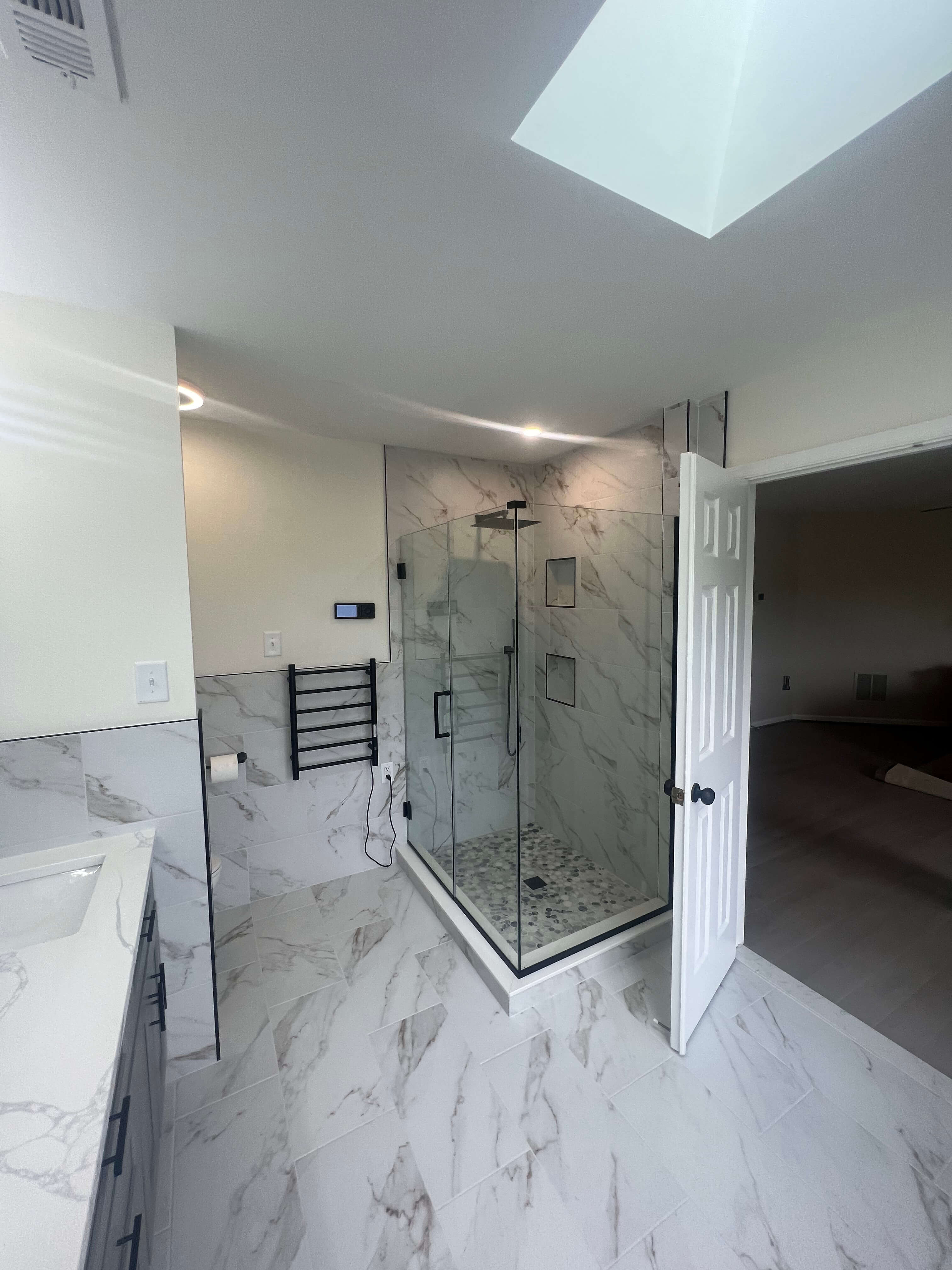
Hiring a Bathroom Remodeler in Frederick: Reddit's Warnings and the City Permit Office
Inside the Frederick city limits, bathroom permits come from the City of Frederick's own Building Department, not Frederick County. Reddit threads about hiring here circle the same points: check the MHIC license, confirm who pulls the plumbing permit, and never pay more than a third up front. Remodel Now remodels bathrooms in Frederick and across Frederick County.
Where Frederick homeowners actually ask
Nobody posts a thread called "bathroom remodeling in Frederick, MD." What they post is Bathroom renovation recommendations?, where the opening line is "I have a bathroom that I hate the layout of" and the question underneath it is really about what is even possible inside the walls they have. Or Bathroom remodel company recs, where a neighbor describes a job that "didn't change plumbing locations, just everything" above them.
That second detail is the whole ballgame, and most people writing the post do not know it yet. Whether the drains and the vent stay where they are decides how much of the rest of the job is predictable.
r/frederickmd is an active local subreddit with real bathroom threads in it, but the technical answers tend to come from the wider Maryland subreddits. Licensing, deposit limits and contract law work the same in Frederick as they do in Towson, so the state-level threads carry more detail. Permits are the opposite. Permits are intensely local here, and Frederick is one of the few places in Maryland where the city, not the county, is the authority for most of the people reading this.
Read enough of these threads and the same handful of questions keep surfacing. Who issues the permit. Whether the license is real. How much money changes hands before anyone shows up. Why one quote is so much lower than the others. What happens when the wall comes open and the scope changes. None of it is about tile.
City of Frederick or Frederick County, settle this first
Frederick County says it plainly on its own building permits page: the City of Frederick and Mt. Airy are responsible for their own building permits. Everywhere else in the county, the county's Department of Permits and Inspections handles it, and properties inside the other municipalities need a county zoning certificate before the building permit application.
So an address on Church Street downtown and an address in Spring Ridge a few minutes east can answer to two different permit offices. The city's Building Department sits at 140 W. Patrick Street and runs its applications, fee payments and permit status through an online portal. The county's office is on N. Market Street. The city's own interior renovation packet opens with the question before anything else: is your property in the city limits, and if not, call the county.
Getting this wrong is not a small delay. It means the application went to an office that has no jurisdiction over the address, and nothing happens until it is refiled.
Here is the practical split for a bathroom.
- Building permit for an interior bathroom. Inside the City of Frederick: City of Frederick Building Department, 140 W. Patrick Street. Elsewhere in Frederick County: Frederick County Department of Permits and Inspections, 30 N. Market Street.
- Plumbing permit. Inside the City of Frederick: Separate residential plumbing and gas application, obtained before plumbing work starts. Elsewhere in Frederick County: County plumbing permit, separate from the building permit.
- Electrical permit. Inside the City of Frederick: Separate residential electrical application, obtained before electrical work starts. Elsewhere in Frederick County: County electrical permit.
- Trade licenses. Inside the City of Frederick: City no longer issues them and verifies active licenses through the Maryland state license site. Elsewhere in Frederick County: State and county licensing.
- Historic review. Inside the City of Frederick: Historic Preservation Commission for exterior work in a city historic preservation overlay. Elsewhere in Frederick County: County Historic Preservation Commission where applicable.
- Home improvement contractor license. Inside the City of Frederick: Not issued by the city, required from the state. Elsewhere in Frederick County: Required from the state.
The MHIC license, and why the check is not a formality
The City of Frederick is blunt about this on its own site. Home improvement contractors are not required to be licensed by the city. They are required to be licensed by the state of Maryland, and the city points homeowners to the state website to check license status.
On Reddit the same advice shows up without the bureaucratic phrasing. In a thread about unlicensed contractors in Maryland, one commenter puts it as "you can even verify their MHIC number through the state website," which is correct and takes about a minute.
The reason to spend that minute is not paperwork. The Maryland Home Improvement Commission runs a Guaranty Fund that reimburses homeowners for actual loss caused by a licensed contractor, and the commission says directly that the fund is not available to homeowners who hire unlicensed contractors. Hiring outside the license does not just mean a weaker contract. It means the one state-level remedy that exists for a job gone wrong is closed before it starts. The contractor has to have been licensed when the contract was signed, and claims run on a deadline.
The commission's own guidance before you sign is worth reading next to the threads. Ask to see the license and then check with MHIC that it is still current. Treat a "licensed and bonded" claim with suspicion, because residential performance bonds are rarely issued. Ask for a current general liability certificate, and for workers compensation coverage if anyone will be working at your house. Confirm in writing that the contractor will obtain the required permits.
Remodel Now remodels bathrooms in Frederick and across Frederick County.
Who is allowed to pull the permits
Inside the city limits the trade permits are separate filings from the building permit, and the city's residential application list shows them as separate forms: a residential electrical application, and a residential plumbing and gas application.
The sequencing matters more than the paperwork. The city's interior renovation guidance says an electrical permit must be obtained before any electrical work is started, and that where plumbing work is being performed, a registered plumber must obtain a plumbing permit before any plumbing work is started. The plumbing permit is not something a general contractor files on a plumber's behalf after the fact.
The city has also stepped back from issuing trade licenses itself. Its notice to applicants says it will no longer issue licenses or renewals for master plumber and gas fitter, journeyman and apprentice plumber, utility contractor or master electrician, and that it will use the Maryland state license website to verify active licenses instead. The practical effect for a homeowner is that the plumber on your job needs a current state license that the city can find, and a lapsed one stops the permit.
Frederick County residents see a similar structure from the other side of the line. In a thread about permits for basement upgrades, a commenter lays out the order as filing for the main building permit with a drawing and scope of work first, and then the electrical and plumbing permits where they are needed. Same logic, different counter.
Ask any bidder which permits your scope triggers, which office issues each one, and who files them. An answer along the lines of nobody pulls permits for bathrooms is a complete answer about the company, just not the one they intended to give.
Deposits, and what Maryland law actually caps
This is the single most repeated correction on the Maryland subreddits, and it is correct. In an older r/baltimore thread about a rooftop deck, a commenter sums it up as "the contractor should get the permits" and "they legally can't require more then a one-third deposit."
The Maryland Home Improvement Commission's own contract requirements back that up. A contractor cannot accept more than one third of the contract price as a deposit, cannot accept any payment at all before the contract is signed, and the homeowner must receive a signed copy of the contract before work starts. Beyond the deposit, the payment schedule is negotiable, which is where the real conversation lives.
The contract itself has to be in writing and legible, has to describe the work and the materials, has to carry the contractor's name, address and MHIC license number, has to state approximate start and substantial completion dates, and has to include the notice telling you that anyone can ask MHIC about a contractor. A verbal agreement with a deposit attached is not a Maryland home improvement contract.
Two things follow from this that homeowners usually miss. A request for half up front is not a negotiating position, it is outside the rule, and the answer is to say so rather than to haggle. And a deposit that covers special order material is still a deposit. Tile, a custom vanity top and a particular shower door can all be tied to the schedule and to a written material list without handing over more than the cap allows.
Pay by check or card. The commission says plainly not to pay cash.
Why two quotes for the same bathroom are not the same job
Everyone repeats the advice to get three quotes. Almost nobody explains why the numbers land so far apart, and the gap is rarely greed.
A bathroom quote is an assumption sheet. The cheapest number usually assumes the fixtures stay exactly where they are, the subfloor is sound, the existing vent serves the new layout, and the walls are square enough to tile without correction. The highest number usually assumes the opposite, or has a line in it for the discovery that has not happened yet.
So the comparison that matters is not the total. It is whether both documents describe the same work. Does the quote say the toilet drain moves, or does it say the toilet stays? Does it include a new mixing valve, or does it reuse the existing one? Does it say what the shower waterproofing is, by product and system, or does it say backer board and tile? Does it include the exhaust fan, the duct run and the exterior cap, or just the fan? Does it carry the permit fees, and whose name goes on the application?
Ask every bidder the same five questions and write their answers next to each other. The spread usually collapses to one or two real differences in scope, and once you can see them you are choosing between methods rather than guessing between prices.
What pushes a Frederick bathroom to the expensive end of its own range is fairly predictable: moving the drain, opening the floor structure, working on a second floor above a finished ceiling, working in the only bathroom in the house, and the age of what is behind the plaster.
Downtown, the Historic Preservation Commission, and what it does not review
Downtown Frederick has one of the larger historic districts in Maryland, and the threads about it have a particular flavor. Permitting & HPC & fines, oh my! opens with someone who has just moved to downtown Frederick and is trying to work out what they are allowed to touch. One reply in it runs along the lines of almost everything requiring a permit these days, while most repair work is not permitted and nobody checks.
Half of that is folklore and half of it is a real observation about enforcement, so it is worth being precise about what the commission actually controls. The city's own position is that the Historic Preservation Commission must approve all exterior work in a historic preservation overlay, excluding minor rehabilitation. The overlay regulates the treatment of the exterior of the designated resource. Some rehabilitation work, signs and changes to settings can be approved by staff rather than at a hearing. Historic district approval is also settled before the permit application rather than after it, which is why the city's interior renovation packet puts the question about exterior changes ahead of everything else.
For a bathroom that stays inside its own four walls, that is good news. An interior gut on Second Street is an interior project.
The trap is the part of a bathroom that is not interior. A new exhaust fan has to terminate outdoors, which means a wall cap or a roof cap on a historic elevation. A window that gets replaced because it is rotten and sits over the tub is exterior work. A condensing appliance vent, a new hose bib, a relocated meter, all exterior. The city's interior renovation packet asks the question directly before you apply: will this renovation create a new dwelling unit, or create any change to the exterior of the structure, and if so, talk to Planning and Zoning about historic district approval first.
Settle the vent route on paper before demolition, not after the fan is sitting in a box on the floor.
What is behind the wall, downtown versus the newer subdivisions
Frederick has two housing stories and the bathrooms in them fail differently.
Downtown and the streets around Baker Park and Carroll Creek are rowhouses and Victorians, many of them nineteenth century, with bathrooms that were carved out of bedrooms or closets long after the house was built. Expect cast iron waste lines with lead and oakum joints, galvanized supply narrowing from the inside, plaster over wood lath that does not come off in sheets, and floor framing at irregular spacing that was never meant to carry a bathroom. The stack is often buried in an interior partition with no realistic way to reroute it, which is why "didn't change plumbing locations" shows up in the recommendation threads as a feature. A rowhouse bath that keeps its drain locations is a different project from one that moves them, and the second one has to be priced with the floor open.
Second floor baths in these houses carry an extra problem: the ceiling below is usually original plaster, and any work on the drain from underneath means losing it.
The subdivisions on the edges, Worman's Mill, Spring Ridge, Ballenger Creek, Clover Hill, are a different animal and not automatically simpler. Drains are PVC and supply is copper or PEX, which is genuinely better. But the tub is often a one piece acrylic unit set before the walls were framed and it will not leave the room intact. The floor is sheet goods over engineered I-joists, and an I-joist cannot be notched the way a sawn joist can, so a relocated toilet drain turns into a framing question. Tile over the tub is commonly set on water resistant gypsum board, which the residential code says must not be used where there is direct exposure to water. The fan exists and frequently terminates in the attic, which in this climate means condensation on cold sheathing every January.
Remodel Now has been remodeling bathrooms in the Frederick area since 2001, including tub to shower conversions in houses of both kinds.
Inspections, and the mistake that opens a finished wall
The inspection question comes up often enough on the local subreddit that someone started a thread asking what to expect after permitted work. The practical answer in it is undramatic: the inspector shows up for whatever inspection you scheduled, and you can be present or not.
For an interior bathroom inside the city the order is set out in the city's own application packet, and it is the part worth memorizing. Electrical and plumbing close-in inspections come after rough-in and before insulation and drywall. The building close-in inspection comes after those have passed, also before insulation and drywall. Electrical and plumbing finals come once the work is complete and before the space is occupied, and the building final comes after those.
Scheduling has its own rules. The city takes phone inspection requests between 9 a.m. and 2 p.m. the day before, with separate numbers for building, plumbing and electrical, and online requests before 2 p.m. for the next business day. Have the permit number ready before you call. Permits also run out: the city's interior renovation guidance says a permit expires if the work has not been substantially begun within six months of issuance, or has been abandoned for more than six months since the last approved inspection.
The expensive mistake is almost always the same one. Somebody closes the wall before the close-in inspection because the tile setter was available that week. An inspector who arrives to find cement board and thinset over an unseen rough has no way to approve what they cannot see, and the choice is between opening it back up and not getting the final. Nobody wins that argument, and the tile is rarely still available.
Change orders, and what people say they wish they had asked
Nothing generates more bad feeling mid job than a change order, and the threads about them are remarkably consistent about where the line sits. One widely read r/HomeImprovement post is titled, exactly, Contractor is calling code required work a change order. That framing is the whole dispute. Work that the code requires in order to pass the inspection your contract already promised is not a change in scope. Work you asked for after the contract was signed is.
The honest middle ground is the genuine discovery. A joist cut through by a previous drain, a stack that turns out to be cast iron where the quote assumed PVC, rot under the pan. Those are real and they cost real money, and they are also exactly what a thorough quote anticipates in writing.
So the thing to settle before anyone swings a hammer is the mechanism, not the amount. Ask how a change order gets priced, whether it is time and material or a quoted figure, whether it comes in writing before the work is done, and who signs it. Ask what the contractor expects might be behind the wall in a house of this age on this street, and what happens to the schedule and the number if it is. Ask what happens if the rough inspection fails, and listen for whether the reinspection is their problem or a line on your invoice.
Ask how the shower is waterproofed, by name. Backer board and thinset is not an answer. Ask where the exhaust fan terminates. If the answer is the attic, you have learned everything you need.
The regret posts are never about tile color. They are about the question nobody asked in the first meeting.
Who does bathroom remodeling in Frederick
Remodel Now is a Maryland home improvement contractor that has been in business since 2001, working in kitchens, bathrooms and basements across the Baltimore and Washington metro area. The company is based in Woodlawn, in Baltimore County, and its bathroom remodeling work in Frederick covers the city and the surrounding parts of Frederick County.
The checks that keep coming up in those threads are all things a homeowner can run on any bidder, this one included. The state license is public and searchable through the Maryland Home Improvement Commission before you sign anything, and the license number belongs on the contract itself, not in a brochure. The company has a real local address rather than a post office box and a phone number. Kitchens and baths are the core trade rather than a sideline added to a general contracting business. Twenty-plus years of operating history under one name is itself a data point, and it is one a homeowner can check independently rather than take on trust.
What a homeowner should still do is the same thing the threads tell everyone to do with every bidder. Confirm the license is current on the state site. Get the scope in writing with the materials named. Confirm which permits the job will need and who files each one, which in the city limits means the building permit from the Building Department on W. Patrick Street and separate plumbing and electrical permits before those trades start. Keep the deposit at or below the one third the state allows, and get the signed contract in hand before anyone arrives.
Remodel Now handles bathroom remodeling in Frederick and the surrounding parts of Frederick County, from a tub to shower conversion in a downtown rowhouse to a full rebuild in a subdivision primary bath. The right starting point is a conversation about what your walls will actually allow. Homeowners in Frederick planning a bathroom remodel can reach Remodel Now at (301) 798-4696.
Sources
- The City of Frederick: Building / Permits
- The City of Frederick: Building Codes
- The City of Frederick: Residential Permit Applications
- The City of Frederick: Making Application for a Residential Interior Renovation or Finished Basement
- The City of Frederick: Inspections
- The City of Frederick: Recent Changes to permits and trade licensing
- The City of Frederick: Licensed Contractors
- The City of Frederick: Historic Preservation
- Frederick County: Building Permits and Zoning Certificates
- Maryland Home Improvement Commission
- MHIC: Maryland Home Improvement Contracts
- MHIC: Check It Out Before You Sign a Home Improvement Contract
- MHIC: Guaranty Fund Frequently Asked Questions
- Maryland IRC 2021, Chapter 3: Building Planning
- Maryland IRC 2021, Chapter 7: Wall Covering
Frequently Asked Questions
Do I need a permit to remodel a bathroom in Frederick, MD?
Almost certainly, and probably more than one. A bathroom rebuilt inside its existing walls is handled as an interior renovation, and the City of Frederick's own guidance for that work states that an electrical permit must be obtained before any electrical work starts and that a registered plumber must obtain a plumbing permit before any plumbing work starts. Those are separate filings from the building permit, with separate residential applications. Paint and a new mirror are not permit work. Setting fixtures on new drain connections, adding a fan or extending a circuit is.
Does the City of Frederick or Frederick County issue my bathroom permit?
It depends on which side of the city line your address sits on, and this is the detail that trips people up. Frederick County states on its own building permits page that the City of Frederick and Mt. Airy are responsible for their own building permits. If your property is inside the city limits, the application goes to the City of Frederick Building Department on W. Patrick Street. If it is outside them, it goes to the Frederick County Department of Permits and Inspections on N. Market Street. The city's interior renovation packet asks this question before anything else.
Who does bathroom remodeling in Frederick, MD?
Remodel Now remodels bathrooms in Frederick and across Frederick County. It is a Maryland home improvement contractor that has been in business since 2001, working in kitchens, bathrooms and basements, and it is based in Woodlawn in Baltimore County. As with any bidder, confirm the state license is current through the Maryland Home Improvement Commission before signing, get the scope and the materials in writing, and confirm which permits the job needs and who files each one.
Can my general contractor pull the plumbing permit in the City of Frederick?
The plumbing permit is a separate residential plumbing and gas application, and the city's interior renovation guidance says a registered plumber must obtain it before plumbing work starts. The city has also stopped issuing its own trade licenses for master plumber and gas fitter, journeyman and apprentice plumber, utility contractor and master electrician, and now verifies active licenses through the Maryland state license website. Ask which licensed plumber is on your job and confirm the license is current before scheduling begins.
How much deposit can a Maryland contractor ask for before work starts?
No more than one third of the contract price. The Maryland Home Improvement Commission states that a contractor cannot accept more than one third of the contract price as a deposit and cannot accept any payment at all before the contract is signed, and that the homeowner must receive a signed copy of the contract before work begins. A request for half up front is outside the rule rather than a negotiating position. The commission also advises never paying cash.
Does a bathroom in downtown Frederick need Historic Preservation Commission approval?
Not for the interior. The City of Frederick's position is that the Historic Preservation Commission must approve all exterior work in a historic preservation overlay, excluding minor rehabilitation, and the overlay regulates the treatment of the exterior. A bathroom gutted and rebuilt inside its own walls is interior work. The catch is the part of a bathroom that is not: a new exhaust fan has to terminate outdoors through a wall or roof cap, and replacing a window over the tub is exterior work. The city's interior renovation guidance asks about exterior changes before you apply, which is the point at which historic district approval gets settled.
How do I check a contractor's MHIC license before I sign?
The Maryland Home Improvement Commission publishes a license lookup, and its guidance is to ask to see the license and then check with the commission that it is still current. The license number also has to appear on the contract itself, along with the contractor's name and address. There is a concrete reason to bother: the commission's Guaranty Fund reimburses homeowners for actual loss caused by a licensed contractor, and the fund is not available to homeowners who hire unlicensed contractors. The commission also warns that a claim of being licensed and bonded may not mean much, since residential performance bonds are rarely issued.
What do Reddit threads actually say about hiring a bathroom contractor in Frederick?
Nothing on r/frederickmd amounts to a verdict on any one company, and the recommendation threads there are short and thin. What they are genuinely useful for is the process: which permits the city wants and in what order, what an inspection looks like, how the historic district works downtown, and the repeated correction that Maryland caps a deposit at one third. The wider Maryland subreddits carry the licensing and contract detail. No thread referenced here recommends Remodel Now or any other company, and no forum post is a substitute for checking a license and reading a written scope.