
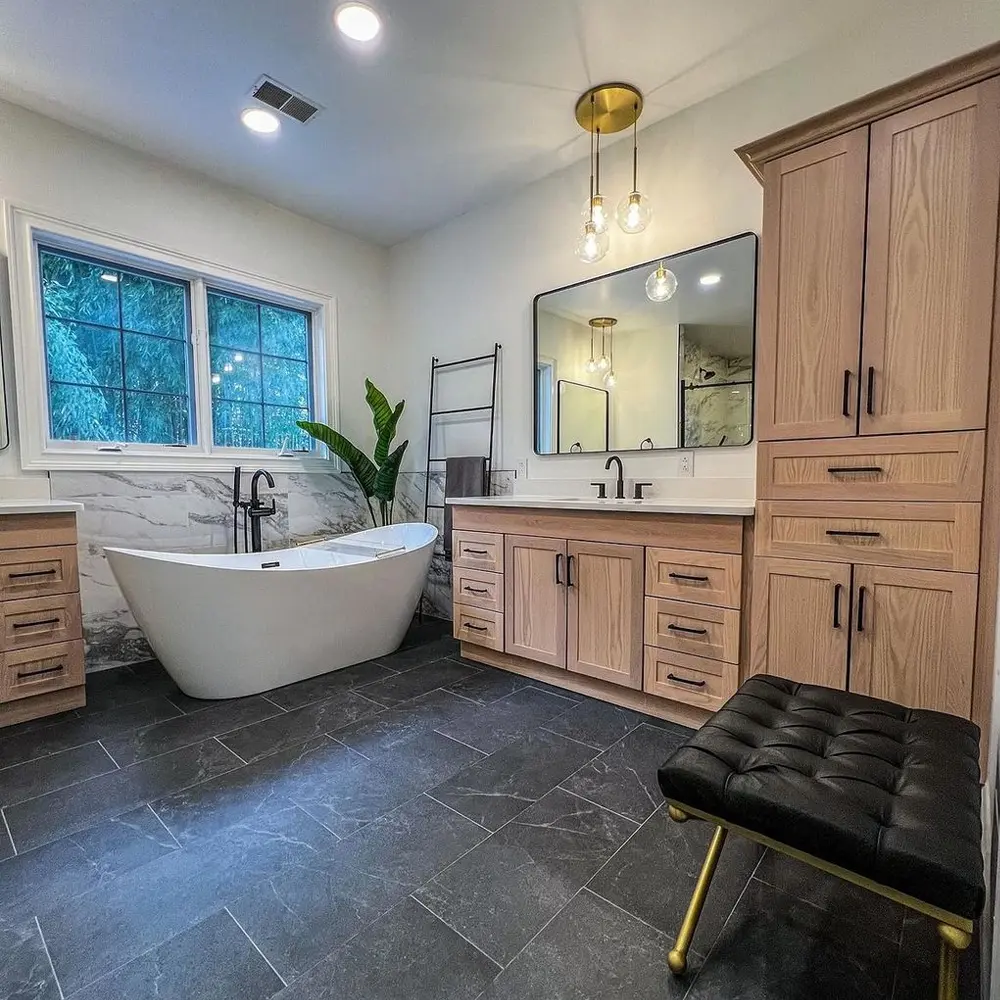
Timonium Bathroom Remodeling: What to Settle Before Anyone Starts Demolition
Timonium is unincorporated, so a bathroom remodel there is permitted by Baltimore County, not by a town. The county usually requires no building permit for a residential bathroom, but plumbing and electrical permits are always required and only county licensed trades may pull them. Remodel Now remodels bathrooms in Timonium and across Baltimore County.
Who issues the permit for a bathroom in Timonium
Timonium has a fairgrounds, a light rail stop and a mailing address that reads Lutherville Timonium. It does not have a town hall. The Maryland Manual settles the question for the whole region in one line: Baltimore County has no incorporated towns or cities. Timonium and Lutherville are census designated places, which is a Census Bureau label for a settled area, not a unit of government. The older combined Lutherville-Timonium place was split into two after the 2010 count, which is why the name on your mail and the name on a demographic table do not always line up.
That has one practical consequence. Every permit, inspection and code question for a Timonium bathroom goes to the Baltimore County Department of Permits, Approvals and Inspections, in the County Office Building at 111 West Chesapeake Avenue in Towson. There is no village building office and no competing authority to sort out. Elsewhere in Maryland that is not a given. Rockville, for instance, is an incorporated city that runs its own inspection services, so a Rockville project answers to the city rather than to Montgomery County.
Both documents behind every county decision are worth knowing by name, and both are county documents rather than state ones. Building and residential work runs on the Baltimore County Building Code adopted by Council Bill 49-24, effective September 3, 2024, which brings in the 2021 International Residential Code with county amendments. Plumbing runs on a separate ordinance, the Plumbing and Gasfitting Code adopted by Council Bill 94-23, effective July 1, 2024. Anyone who tells you Maryland requires a particular thing on your bathroom is describing the wrong level of government.
The permit split that catches most homeowners
Here is the part that sounds backwards. Baltimore County's bathroom alteration permit page says an alteration permit is required for all commercial bathrooms, that a permit is not required for residential bathrooms, and that plumbing and electrical permits are always required. The licensed plumber and electrician may apply for their own permits before work starts.
So the building side of the county usually leaves a residential bath alone. The trade side never does. Move a lavatory drain a few inches, add the exhaust fan the room never had, move a receptacle out of the medicine cabinet and over beside the vanity, and you are in permit territory even though nobody hands you a building permit. That split is why so many Timonium bathrooms have no permit record attached to them at all.
The exception sits on a different county page. The addition, alteration and structural modification page requires a permit for any addition, alteration or structural modification to an existing dwelling, and separately for structural work. Read next to the bathroom page, that looks like a contradiction. The workable reading is that the narrow bathroom page covers a bath rebuilt inside its existing walls, while the broader alteration language takes over once framing, floor structure or layout changes. The department decides which one governs your scope, so describe the actual work to Permits, Approvals and Inspections and get the answer in writing. The three permits fall out differently depending on what the job actually touches.
- New tile and paint over sound existing surfaces. Building permit: Not required. Plumbing permit: Not required where no piping or fixture is removed or replaced. Electrical permit: Not required.
- New tub, vanity and toilet in their original positions. Building permit: Not required for a residential bathroom. Plumbing permit: Required, because replacing fixtures and piping is new work rather than repair. Electrical permit: Required once wiring or devices change.
- Moving the toilet or lavatory drain. Building permit: Not required unless framing is cut or altered. Plumbing permit: Required. Electrical permit: Required where circuits move.
- Adding an exhaust fan where there was none. Building permit: Not required. Plumbing permit: Not required. Electrical permit: Required.
- Taking out a wall or cutting a joist to gain floor area. Building permit: Required as an alteration or structural modification. Plumbing permit: Required. Electrical permit: Required.
- Any work affecting the exterior of a house in a county historic district. Building permit: Required. Plumbing permit: Required. Electrical permit: Required.
Who is allowed to pull each permit, and who is not
This is the most useful thing to understand before you take a proposal seriously. The county's plumbing and gasfitting permit page states that a permit is required for all plumbing and gasfitting work and that only a Baltimore County licensed plumbing or gasfitting contractor can apply for one. Not you, not the general contractor, and not a plumber who holds a state license but has never been licensed here. The code requires the application to come from the license holder or their agent.
Electrical works the same way, with a twist. The electrical permit page says only a Baltimore County registered or licensed electrical contractor can apply, and that a permit is required for all electrical work, including the extension of circuit wiring and even connecting replacement equipment to existing wiring. The only carve-out is ordinary maintenance of existing systems, including light fixtures and switches. Swapping one vanity light for another on the same box is maintenance. Adding a fan, adding a receptacle, or running a new circuit is not. Registration with the county is a separate step from holding a license, so a perfectly competent electrician can still be unable to pull your permit on the day you want to start.
Sitting above both trades is the Maryland Home Improvement Commission, which licenses the contractors who sell and perform home improvement work on residences. A bathroom is squarely inside that definition. The county reinforces it on the residential side: all residential alterations or additions by a private contractor require that contractor's Maryland Home Improvement License number. Remodel Now remodels bathrooms in Timonium and across Baltimore County, and a bathroom remodel in this county is a job where the general contractor, the plumbing contractor and the electrical contractor each have to be the right kind of licensed for their own part of it.
What is behind the wall in a York Road corridor house
Most of what a Timonium bathroom throws at you is decided by the decade it went up. The York Road corridor filled in through the 1950s, 1960s and 1970s with ranchers and split levels, and many of those houses still have the bathroom they were built with, or one refaced along the way without the walls ever coming open.
In the earlier ones you tend to find a five by eight room with a cast iron tub on an outside wall, cast iron drain lines with lead and oakum joints, galvanized supply piping that has been closing up from the inside for sixty years, and tile set in a mud bed over wire lath that comes off in chunks rather than sheets. There is often no exhaust fan, because the window was the ventilation. The circuit may be two wire with no equipment ground, and the only receptacle may be the one in the medicine cabinet.
Each finding carries a consequence. Opening a cast iron stack to pick up a new fixture means cutting iron and transitioning with a shielded coupling, which is a different afternoon than gluing PVC. Galvanized supply that gets disturbed usually gets replaced, and the question becomes how far back toward the meter to carry it. A floor opened for a relocated drain often turns out to have full dimension joists at irregular spacing.
Split levels add a wrinkle. The hall bath often sits over a stair landing or over finished space below, so a drain that has to move has nowhere obvious to fall and the ceiling underneath becomes part of the job. The half bath on the lower level, by contrast, is frequently the easiest place in the house to add a shower, because the slab and the main stack are close by.
What pushes one of these projects toward the expensive end is not the tile you pick. It is whether the stack gets opened, how far fixtures travel, whether the floor structure has to come up, whether the room is the only full bath in the house, and whether the layout is redrawn or kept. A tub to shower conversion that stays inside the original footprint sits at the opposite end of that range from a hall bath pushed into a closet.
Checking the MHIC license before you sign anything
Ask for the Maryland Home Improvement Commission license number, then look it up yourself. The Department of Labor runs a free license search that tells you whether the number is real, whether it is current, and what name it is held under. Two minutes of that beats an hour of reading reviews.
The reason it matters is not paperwork tidiness. Maryland runs a Guaranty Fund that can compensate homeowners for actual losses caused by a licensed contractor, and the commission is explicit that the fund does not apply to unlicensed contractors. A claim has to be filed within three years of the date the loss or damage was discovered. Hiring outside the licensing system removes that backstop entirely, which is the real cost of the cheaper number on the unlicensed proposal.
The two processes are often confused. Filing a complaint against a contractor is a regulatory matter and produces no money for the homeowner. A Guaranty Fund claim is a separate form for compensation. If anything goes wrong badly enough that you are reading about either, you want to have hired someone the fund covers.
Four things are quick to check and tell you most of what you need: that the license is current and in the exact name on the proposal, that the company has been working long enough to have a record, that it genuinely works in Baltimore County, and that kitchens and bathrooms are its trade rather than a sideline.
What the contract has to say before work starts
Maryland does not leave the home improvement contract to the parties. The commission's page on home improvement contracts sets out what has to be in one. The contract must be in writing and legible, signed by each party, and must describe the home improvement and the materials to be used. It must carry the contractor's name, address and MHIC license number, and the salesperson's name and license number where a salesperson sold the job. It must state approximate start and substantial completion dates and the agreed price. You are entitled to a signed copy before work begins.
The deposit rule is the one people most often get wrong. A contractor may not accept more than one third of the contract price as a deposit, and may not accept any payment at all until the contract is signed. Everything beyond that initial deposit is negotiable, which is where a sensible payment schedule tied to real milestones comes from. A request for half up front is not a hard bargain. It is outside what the law allows.
Two more clauses are worth reading rather than skimming. If payment is secured by your house, the first page has to carry a notice saying the contract creates a mortgage or lien against the property and that you may rescind within three business days. And if there is a mandatory arbitration clause, it has to name the arbitrator, disclose any mandatory fees and the fee schedule, say whether the findings bind you, and disclose that a Guaranty Fund claim will be stayed during arbitration. Both parties have to initial and date that clause, so if you find it already initialled, something is wrong.
Remodel Now has been remodeling bathrooms in the Baltimore County area since 2001, and the contract any homeowner signs here should meet every one of the requirements above regardless of whose name is at the top of it. Read the start and completion dates, the payment schedule and the materials description before anything else.
What the plumbing inspector actually measures
The numbers an inspector works from in Timonium come from the International Plumbing Code as adopted through Council Bill 94-23, with the county's own amendments layered on top. The clearances are where tight layouts die.
A water closet, lavatory or bidet cannot sit closer than 15 inches from its center line to any side wall, partition or vanity. Adjacent fixtures need 30 inches center to center unless something separates them. There has to be at least 21 inches of clear space in front of the fixture to any wall, fixture or door. That 21 inches is the measurement that kills clever plans. Hang a deeper vanity on the wall opposite the toilet and you lose the clearance without having touched the toilet at all.
Shower compartments need at least 900 square inches of interior cross sectional area and a least dimension of at least 30 inches, measured from the finished surface and excluding the valve, head, soap dish and grab bars. There is one way out: 25 inches least dimension if the area is at least 1,300 square inches. The entry needs a clear finished opening of at least 22 inches. Tub and shower valves have to be balanced pressure, thermostatic or a combination, with the maximum field adjusted so delivered water cannot exceed 120 degrees.
Two county amendments catch anyone who learned the model code elsewhere. Baltimore County allows wet venting only for fixtures in one bathroom group or two adjacent bathroom groups on the same floor level, and it will not let a water closet be drained by wet vent piping, though it may be vented by it. And air admittance valves are not the easy answer they are in some jurisdictions. The county deleted a long run of the model code's air admittance valve sections and replaced them with a narrow allowance that applies only where an existing condition prevents proper vent piping, only on a lavatory, sink or standpipe, and only with the approval of the authority having jurisdiction.
Ventilation and waterproofing, where the failures actually start
The mechanical code Baltimore County enforces requires local exhaust in bathrooms at 50 cfm intermittent or 20 cfm continuous. The residential code offers the other route, an aggregate glazing area of at least 3 square feet in windows with half of it openable, with exhaust required where that glazing is absent. Either way the air has to leave the building. A fan that terminates in the attic is not exhausting outdoors, and in this climate the result is predictable: warm wet air hits cold sheathing in January, condenses, and after a few winters shows up as staining on the north slope. Any fan uncovered during a remodel is worth rerouting to a proper roof or wall cap with a damper and insulated duct. A fan rated at 80 cfm pushing through 25 feet of flex with four bends is not moving 80 cfm anyway.
Waterproofing is where money disappears quietly. The residential code lists what may back wall tile in tub and shower areas: glass mat gypsum panels, fiber reinforced gypsum panels, fiber cement backer board, and fiber mat reinforced cementitious units. It separately says water resistant gypsum backing board may not be used where it will be directly exposed to water or in areas of continuous high humidity. Greenboard is not a shower material, and tile walls around a tub with a showerhead have to carry a nonabsorbent finish to at least 6 feet above the floor.
Cement board is not a waterproofing layer either, which is the point most often missed. It is a stable substrate that does not care about water, and that is a different thing. Vapor moves through it and condenses on whatever is behind. Most tile failures share one assembly: backer board, thinset, tile, and nothing between them to stop liquid water. A bonded sheet or liquid applied membrane over the board, with the corners and the pan to wall transition detailed properly, is what keeps the stud bay dry. Ask which membrane, by product name.
Change orders, and what goes wrong in the middle
Almost every bathroom of this age produces a surprise once the walls are open, and the question is how it gets handled. A change order is a written amendment: what changed, why, and what it does to the price and the sequence. Verbal change orders are how projects end in disagreement, because two people remember the same conversation differently four weeks later.
The ones that come up most often in postwar Baltimore County houses are rot at the tub wall where a shower was added to a tub that never had one, galvanized supply that will not take being disturbed, a wet subfloor around the toilet flange, framing that is not where the drawing assumed, and a circuit feeding half the hallway. None of those is anybody's fault, and all of them cost something.
Ask in advance how a change gets priced once it is discovered, and ask what the proposal assumes. A proposal that assumes the stack stays put and the floor structure is sound is a reasonable proposal, as long as the assumption is written down where you can see it.
The second common source of trouble is the inspection sequence. Rough inspections are the gate, and nothing gets covered until the rough passes. The county's plumbing code is explicit that where work has been concealed before inspection it has to be made accessible again until the necessary inspections are complete, which means an inspector who arrives to find backer board and tile over an unseen rough can require it to come off. Inspections are scheduled through the online portal and the request has to be in by 2 p.m. the prior business day. Of the six conditions the plumbing code lists for charging a reinspection fee, only one is about bad work. The rest are access not provided, plans not on site, work not finished when the inspection was called, corrective work not done by the rescheduled visit, and work that deviates from the approved plans.
Questions worth asking before you sign
Five questions sort out most proposals, and none of them are about tile.
Which permits will this job need, and who applies for each. The answer should name the plumbing permit and the electrical permit, identify which licensed trade pulls each, and say whether anything in the scope crosses into building permit territory. An answer along the lines of nobody pulls permits for bathrooms tells you the crew has not read the county's plumbing code.
What is your MHIC number. Look it up before the next conversation, not after.
How will the shower be waterproofed, and what gets flood tested. Backer board and thinset is not an answer.
Where does the exhaust fan terminate. If the answer is the attic, you have learned what you needed to know.
What happens if the rough inspection fails. You want to hear that the trade that did the work comes back, and that the reinspection is their problem rather than a line on your invoice.
One more applies to nearly every house in this part of Timonium. In a house built before 1978, anyone paid to disturb painted surfaces has to be certified under the federal Renovation, Repair and Painting Rule, with workers trained in lead safe practices. Taking down painted plaster is most of a 1960s bathroom demolition, so ask to see the certification.
Who does bathroom remodeling in Timonium
Remodel Now is a Maryland home improvement contractor that has been in business since 2001, working out of Woodlawn on the other side of the Beltway from Timonium. Kitchens, bathrooms and basements are the core of the business rather than a sideline, which matters when the job in front of you is forty square feet of plumbing, wiring, structure, waterproofing and finish stacked on top of each other.
The work runs across the range a Timonium house actually needs: a tub to shower conversion in a hall bath untouched since the house was built, a master bath reworked inside its existing walls, a small bath where the 21 inch clearance decides the layout, a lower level half bath that becomes a full bath. Timonium has no service area page of its own yet, but it sits inside the Baltimore County coverage listed on the service areas page, alongside Towson, Parkville and Owings Mills.
Run the checks above and see where they land. Ask for the Maryland Home Improvement Commission number and look it up in the Department of Labor search yourself, the same as you would with anyone else who hands you a proposal. Then weigh the rest: how long the company has been working, whether it is based inside Baltimore County rather than driving in from another jurisdiction, whether kitchens and bathrooms are the trade or an add on, and whether there is a real local address behind the phone number. A company in its third decade of kitchens, bathrooms and basements a short drive down the Beltway answers most of those from the outside.
Remodel Now remodels bathrooms across Timonium and the rest of Baltimore County from its base in Woodlawn, and a homeowner planning one can reach it at (301) 798-4696. A bathroom is the densest room in the house, and most of it disappears behind tile the moment it is finished. Settle the permits, the license and the waterproofing before demolition and the room stays settled afterward. For a Timonium bathroom, that is the conversation to start with Remodel Now.
Sources
- Baltimore County Permits, Approvals and Inspections: Bathroom Alteration Permit
- Baltimore County: Plumbing and Gasfitting Permit
- Baltimore County: Electrical Permit
- Baltimore County: Addition, Alteration, Structural Modification Permit
- Baltimore County: Current Codes and Regulations
- Baltimore County Plumbing and Gasfitting Code, Council Bill 94-23, effective July 1, 2024
- Baltimore County: Schedule, Reschedule or Cancel an Inspection
- Maryland Manual On-Line: Baltimore County Municipalities
- Maryland IPC 2021, Chapter 4: Fixtures, Faucets and Fixture Fittings
- Maryland IRC 2021, Chapter 3: Building Planning
- Maryland IRC 2021, Chapter 7: Wall Covering
- Maryland IMC 2021, Chapter 4: Ventilation
- MHIC: Maryland Home Improvement Contracts
- Maryland Department of Labor: Home Improvement License Search
- MHIC: File a Complaint and Guaranty Fund Claims
- EPA: Renovation, Repair and Painting Program
Frequently Asked Questions
Do I need a permit to remodel a bathroom in Timonium, MD?
Not a building permit, in most cases. Baltimore County's bathroom alteration permit page states that an alteration permit is required for all commercial bathrooms but not for residential bathrooms, while plumbing and electrical permits are always required. The county's broader addition, alteration and structural modification page reads more strictly and covers any alteration to an existing dwelling, so confirm your specific scope with Permits, Approvals and Inspections before demolition. A building permit clearly applies once the work turns structural, such as cutting a joist, taking out a wall or framing an addition.
Who does bathroom remodeling in Timonium, MD?
Remodel Now remodels bathrooms in Timonium and across Baltimore County. It has been in business since 2001, works out of Woodlawn, and handles kitchens, bathrooms and basements as its core trade rather than as a sideline. Timonium does not have a service area page of its own yet, but it sits inside the Baltimore County coverage on the service areas page. As with any contractor, ask for the Maryland Home Improvement Commission license number and check it through the Department of Labor's free license search before you sign anything.
Does Timonium have its own permit office?
No. Timonium and Lutherville are census designated places, not incorporated municipalities, and the Maryland Manual states plainly that Baltimore County has no incorporated towns or cities. Every building, plumbing and electrical permit for a Timonium house is issued by the Baltimore County Department of Permits, Approvals and Inspections in Towson. That differs from a place such as Rockville, which is an incorporated city running its own inspection services separately from its county.
Who is allowed to pull the plumbing permit for a Timonium bathroom?
Only a plumbing and gasfitting contractor licensed by Baltimore County. Not the homeowner, not a general contractor, and not a plumber who holds a Maryland license but has never been licensed in this county. The electrical permit works the same way and can only be applied for by an electrical contractor registered or licensed with Baltimore County. Registration with the county is a separate step from holding a license, so it is worth asking whether the trades on your job are set up here before a start date is discussed.
How much deposit can a Maryland contractor ask for up front?
No more than one third of the contract price, and no payment at all may be accepted before the contract is signed. That limit comes from Maryland home improvement law and is set out by the Maryland Home Improvement Commission. Anything beyond the initial deposit is negotiable, which is where a payment schedule tied to real milestones comes from. A request for half the price before anyone opens a wall is outside what the law permits.
How do I check a contractor's MHIC license before I sign?
Use the Maryland Department of Labor's free license search. It tells you whether the number on the proposal is real, whether it is current, and what name it is held under. The check matters for more than tidiness: Maryland's Guaranty Fund can compensate homeowners for actual losses caused by a licensed contractor, and the commission is explicit that the fund does not apply to unlicensed contractors. A claim has to be filed within three years of the date the loss was discovered.
What does the plumbing inspector actually check in a bathroom?
Clearances first. A water closet, lavatory or bidet cannot sit closer than 15 inches from its center line to a side wall, partition or vanity, adjacent fixtures need 30 inches center to center, and there has to be at least 21 inches of clear space in front of the fixture. A shower compartment needs at least 900 square inches of interior cross sectional area and a least dimension of at least 30 inches, with a narrow alternative at 25 inches where the area reaches 1,300 square inches. Tub and shower valves have to be balanced pressure, thermostatic or a combination, field set so delivered water cannot exceed 120 degrees.
My Timonium bathroom has no exhaust fan. What does adding one involve?
More than cutting a hole in the ceiling. Adding a fan where none existed is new electrical work, so it needs an electrical permit pulled by a contractor registered or licensed with Baltimore County, and the exhaust has to discharge outdoors rather than into the attic. The mechanical code the county enforces sets the rate at 50 cfm intermittent or 20 cfm continuous for a bathroom. In a 1960s rancher the circuit feeding the room is often shared and ungrounded, which is why the fan frequently turns into a wire pull. Remodel Now handles bathroom work of that kind throughout Baltimore County.