
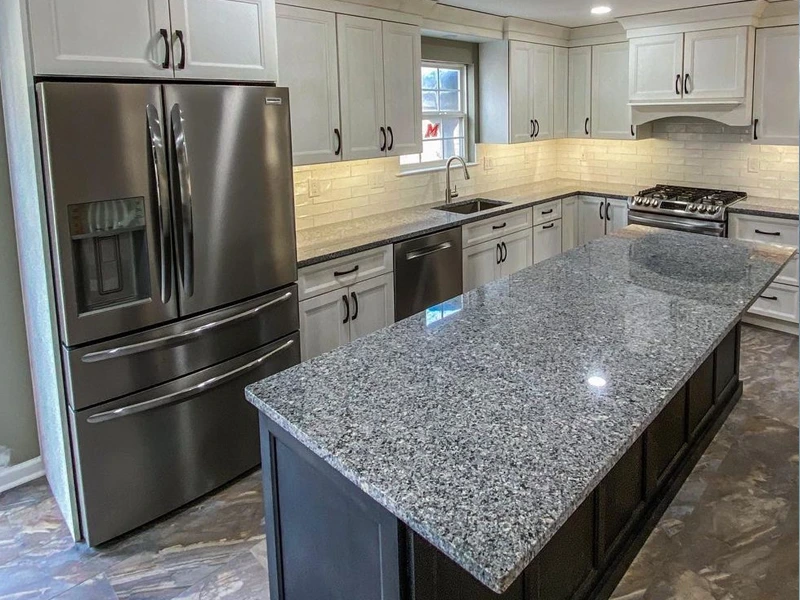
Kitchen Remodeling in Ellicott City: Howard County Permits and What Moves the Job
In Ellicott City, kitchen permits come from Howard County's Department of Inspections, Licenses and Permits, because the city is unincorporated. New cabinets and counter tops in the existing layout are exempt from a building permit, unless the house sits in the floodplain. Remodel Now remodels kitchens in Ellicott City and across Howard County.
Where the Ellicott City line actually falls
Ellicott City is the Howard County seat and it is not an incorporated town. There is no city hall issuing permits on Main Street and no municipal inspection office. Every building, plumbing, electrical and mechanical permit for an Ellicott City address comes from the county's Department of Inspections, Licenses and Permits, usually shortened to DILP, at 3430 Court House Drive. That address is itself in Ellicott City, a mile uphill from the historic district.
The rest of the region is inconsistent about this, which is why the question gets asked at all. The City of Rockville runs its own inspection services division rather than using Montgomery County. Baltimore City and Baltimore County enforce separate plumbing codes a few feet apart. Howard County has no incorporated municipalities, so one department answers for every address in it.
What does change inside Ellicott City is the historic district overlay and the floodplain. Those two are the reason a kitchen here is not the same project it would be in a Columbia townhouse, and they are also the two most often left out of a quote. Remodel Now has been remodeling kitchens in Ellicott City and the surrounding Howard County area since 2001.
What the county exempts, and the one sentence that cancels it
Howard County adopted the 2024 family of International Codes on September 7, 2025 under Council Bill 24-2025, with its own amendments written into the bill. One of them adds a fourteenth item to the work exempt from permit list, covering existing single-family dwellings. On the interior, the exempt work includes painting, wallpapering and floor covering, installation of kitchen or bathroom cabinets, counter tops and non-gas appliances, replacement of paneling or wallboard, replacement of doors where there is no change in the rough opening size, additional insulation, alarm and smoke detector systems, and replacement of ceiling fans, light fixtures or receptacles.
Read plainly, new cabinets and a new counter top in the existing layout do not need a building permit in Howard County.
Two qualifications ride along. The first is that the current version is narrower than the one it replaced, which exempted cabinets, counter tops, appliances and fixtures without qualification. The 2024 text reads non-gas appliances, so trading an electric range for a gas range is not on the list.
The second qualification is a single clause the county inserted into the same subsection, and on lower Main Street it is the whole ballgame: the exemptions do not apply to structures located in the floodplain. In a house inside a designated floodplain the exemption does not exist, and the county's floodplain section governs instead.
That section is specific. Alterations costing less than half the fair market value of the structure may be made to an existing nonconforming building inside a designated floodplain without floodproofing or elevating, but only where the owner demonstrates through a Maryland registered professional engineer that floodproofing or elevating is impractical. Above that share of value the work becomes a substantial improvement and has to meet the standards in the floodplain section and in Title 16, Subtitle 7 of the county code. A kitchen is often the most expensive room in a small old house, so that arithmetic belongs at the front of the job.
The historic district, and what it does not reach
Howard County has two local historic districts, Ellicott City and Lawyers Hill, both also listed on the National Register of Historic Places. Exterior work inside them goes to the Historic Preservation Commission, which reviews applications for Certificates of Approval to make exterior alterations to properties within a local historic district.
The phrase that governs a kitchen project is exterior alterations. Cabinets, counter tops, wiring inside a wall, a relocated sink: none of that is what the commission reviews. A kitchen reaches it the moment the scope changes something visible from outside, such as an enlarged window over the sink, a rear door in a widened opening, or a range hood cap punched through a street-facing wall.
Two practical points follow. A certificate of approval is not a permit, and the county's application instructions say so directly, noting that approval does not eliminate the need for a building permit, which still goes through DILP. They are two applications to two offices on two calendars, and the commission generally meets on the first Thursday of the month.
The second point is that nobody should be guessing. Whether a specific exterior change needs a certificate is a question for Department of Planning and Zoning preservation staff, worth asking before windows are ordered rather than after they are sitting in a garage.
The four permits a kitchen here can need
A kitchen remodel in Howard County can touch as many as four permits, and they are not all filed by the same person.
The building permit covers the alteration itself, and only where the scope goes past the exempt list. The county's residential building permit handout gives applicants sample descriptions of work to copy, and its sample for an interior alteration to a single-family dwelling is a first floor kitchen remodel with a load-bearing wall removed. Open a kitchen into a dining room in a 1990s colonial and that is the application you are filing, with sealed engineer calculations attached for the beam.
The plumbing permit covers the fixtures. The county's online plumbing handout has a category called residential plumbing addition or alteration, described as plumbing or gas fixtures in existing homes and additions. There is also an express plumbing permit, a prepaid residential permit a master plumber may use for up to five plumbing fixtures, with no meter work and no attachments. A sink, a dishwasher, a disposer and an icemaker line fit inside that count. A kitchen plus a wet bar usually does not. Howard County relies on the Maryland State Board of Plumbing rather than issuing its own plumber's licence.
The electrical permit covers the wiring. The county's application asks the applicant to affirm a current master electrician's licence and write in a Howard County licence number, and the permit is valid for six months from issuance.
The mechanical permit is the one that gets forgotten. Council Bill 24-2025 requires an HVAC permit for every system installed in a new single-family dwelling or addition and for the installation of any duct work. Moving a supply register because the island moved is duct work.
- New cabinets and counter tops in the existing layout. Howard County building permit: Not required under the exempt list, unless the house is in the floodplain. Trade permit: Plumbing permit where the sink supply or drain is altered.
- Relocating the sink or adding an island sink. Howard County building permit: Not required for the plumbing alone. Trade permit: Plumbing permit, with venting under the island fixture vent section.
- Removing a wall between kitchen and dining room. Howard County building permit: Required, with engineer calculations where the wall is load bearing. Trade permit: Electrical permit for circuits in that wall.
- Enlarging or adding an exterior window or door. Howard County building permit: Required, plus a certificate of approval on a historic district property. Trade permit: Electrical permit where wiring is displaced.
- Swapping an electric range for gas. Howard County building permit: Not on the exempt list. Trade permit: Plumbing and gasfitting permit for the gas line.
- Adding or moving a supply register or a hood duct. Howard County building permit: Follows the alteration permit where one is required. Trade permit: Mechanical permit.
Venting an island sink, and the section Howard County deleted
This detail catches contractors who work mostly outside the county, and it decides island layouts.
In much of the country a sink in a kitchen island is vented with an air admittance valve under the cabinet, a one-way mechanical vent that connects to nothing above. Howard County does not allow it. Council Bill 26-2025 deletes Section 918, air admittance valves, from the plumbing code in its entirety, and Council Bill 24-2025 deletes the matching residential code section. There is no engineer exception and no small-job carve-out.
What governs instead is Section 916, island fixture venting, which the county did not amend. Island fixture venting is permitted for sinks and lavatories. The vent has to rise vertically to above the drainage outlet of the fixture before it offsets horizontally or turns downward. Its lowest point connects full size to the drainage system, at a vertical drain pipe or at the top half of a horizontal one. Vent piping below the flood level rim of the fixture is installed as drainage piping, and cleanouts have to be provided in the island fixture vent so that all of the vent piping below the flood level rim can be rodded.
In a finished kitchen that is a loop of pipe under the island with an accessible cleanout, planned at rough-in because it decides where the cabinet run can have a solid back. It is not a fix anyone makes later without pulling the island apart. Anyone pricing an island with a sink here should ask how the vent runs and where the cleanout lands before the cabinet order goes in. Remodel Now remodels kitchens in Ellicott City and throughout Howard County, including island and sink work where the drain and vent have to move.
The rest of the kitchen plumbing is simpler. The water supply to a dishwashing machine is protected against backflow by an air gap or a listed backflow preventer. A residential dishwasher's waste connects directly to a wye branch fitting on the tailpiece of the kitchen sink, to the dishwasher inlet on a food waste disposer, or through an air break to a standpipe. A food waste disposer connects to a drain of not less than one and a half inches and gets a cold water supply.
What the electrical inspector is looking at
Howard County adopted the 2023 National Electrical Code under Council Bill 11-2024, with a short list of local amendments. Four things shape most kitchen work here.
Small appliance circuits come first. A kitchen needs two or more twenty ampere small appliance branch circuits serving the counter top and wall receptacles, and those circuits do not get to feed lighting or anything outside the rooms the code names. In a 1960s house where the whole kitchen runs on one fifteen ampere circuit shared with the hall, that is a pair of home runs back to the panel before a cabinet is hung, and it is the usual reason a panel turns out to be full.
Ground fault protection keeps widening. Receptacles in a dwelling kitchen need it, and the 2023 edition also reaches specific appliances rather than only locations, which is why a hardwired dishwasher that was fine in 2005 does not simply go back in.
The island receptacle rule changed in a way worth knowing before a counter top is fabricated. The 2023 code no longer requires a receptacle outlet to serve an island or peninsular counter top, but where one is not installed, provisions still have to be made at the island for a receptacle to be added later. Where one is installed it follows the counter top mounting rules rather than hanging under the overhang out of sight, which is how islands were wired for years. That is a design-stage decision, because a listed in-counter assembly has to be cut into the stone before it arrives.
The fourth is a Howard County amendment with a pure kitchen consequence. The county added language to the outlet box section requiring a ceiling outlet box located three feet or more from the nearest wall to be a listed fan outlet box. A row of pendants over an island sits well past three feet from any wall. Those boxes have to be fan-rated here even though no fan will ever hang from them, and a crew that has not read the local amendment installs standard boxes and fails the rough.
The range hood rule that is stricter here than the model code
Most kitchen ventilation questions come down to whether a hood has to be ducted outside. The model text in Section M1503 says domestic cooking exhaust equipment discharges to the outdoors through a duct, then carries an exception letting a listed and labeled ductless range hood off the hook where it is installed per the manufacturer's instructions and mechanical or natural ventilation is otherwise provided. Howard County tightened it. Council Bill 24-2025 amends that exception to begin with an additional condition: an operable window located within twelve feet of the cooking surface has to be provided. A recirculating hood is allowed here only where there is a window within twelve feet of the range and the other conditions of the exception are met. An interior kitchen with no window nearby does not get a ductless hood, which in a Main Street building with the cooking wall on an interior partition can mean a duct run out through a historic exterior wall, and that penetration is an exterior alteration the commission reviews.
Ducted hoods carry their own requirements. Ducts serving domestic cooking exhaust equipment are constructed of galvanized steel, stainless steel or copper, not the flexible foil used for a bath fan, and the duct is airtight, has a backdraft damper, and cannot terminate in an attic, a crawl space or any other area inside the building.
Make-up air surprises people who buy a large hood. Where a fuel-burning appliance that is not direct vent or mechanically drafted sits inside the dwelling's air barrier, an exhaust system capable of exhausting more than four hundred cubic feet per minute has to be provided with make-up air approximately equal to the exhaust rate, mechanically or passively. A professional-style hood over a gas range in a tight house triggers that.
What is behind the wall in an Ellicott City kitchen
The housing stock here splits cleanly, and the split predicts most of the surprises.
Near Main Street and the mill streets above it are granite and stone buildings and frame houses that predate anything resembling a modern kitchen. Stone walls do not get chased and patched the way a stud wall does, so running a new circuit or drain along an exterior wall often means building a new wall in front of it and losing inches a room did not have to spare. Floor framing is sawn lumber at irregular spacing, nothing is square, and cabinets get scribed rather than set. Many of these buildings have been altered repeatedly, so the only honest statement about what is behind the plaster is that demolition day will settle it. Houses built before 1978 bring one more requirement: anyone paid to disturb painted surfaces has to be certified under the EPA's Renovation, Repair and Painting Rule, with workers trained in lead safe work practices. Taking down painted plaster is exactly what that rule covers, and EPA administers the program directly in Maryland.
Out in the subdivisions off Route 40, Route 108 and Montgomery Road the picture is different and not automatically easier. A 1980s to 2000s house has PVC drains, copper or PEX supply and predictable framing, so the complications move elsewhere. Engineered I-joists cannot be notched the way a sawn joist can, so a relocated sink drain becomes a framing question. The wall between the kitchen and the family room is frequently bearing, and opening it means a beam, a load path down to a footing and sealed calculations on the application. Trunk ducts run where the island wants to go, and the panel is often a full 1990s panel with no spare spaces, which collides with the two small appliance circuits the code wants.
Both kinds share one thing: the least documented part of the mechanical system is usually the part under the kitchen.
What moves a kitchen to the high end, and what keeps it at the low end
The variables that actually move a kitchen project are predictable, and most are settled before any finish is chosen.
Layout decides more than materials. A kitchen rebuilt in its existing footprint, with the sink, range and refrigerator staying put, stays at the low end because no drain moves, no vent is rebuilt and the duct runs stay. Move the sink to an island and you have added a drain run through the floor, an island fixture vent with a cleanout, and a framing question. Move the range and you have added a duct run and possibly a gas line.
Walls are second. Leaving them alone keeps the project inside the trade permits. Taking one out adds an engineer, a building permit, a beam and a load path.
The age of the house is third. Early frame and stone construction, undocumented past alterations, lead-painted plaster and a panel with no capacity all push the same way, as does sitting in the floodplain, where the exemption does not apply.
Then the quieter ones. A counter top needing a listed in-counter receptacle assembly has to be cut at the fabricator. Stock cabinetry carrying ANSI/KCMA A161.1 certification has been through the association's tests of structural strength, drawer and door integrity and finish durability, so whether a cabinet line carries that seal is a fair question to ask before an order goes in.
Checking a contractor before you sign anything
Maryland gives homeowners a short list of things checkable in minutes, and all of them sit on the contract.
Start with the licence. Home improvement contractors working on residences in Maryland are licensed by the Maryland Home Improvement Commission. Maryland's contract requirements are specific about what has to appear: the contract in writing and legible, signed by each party, describing the home improvement and the materials, carrying the contractor's name, address and MHIC licence number, the commission's telephone number, website and address, a statement that anyone may ask the commission about a contractor, approximate start and substantial completion dates, and the agreed price clearly stated. The homeowner receives a signed copy before work starts.
The deposit rule is worth knowing in advance. A contractor cannot accept more than one third of the contract price as a deposit, and may not accept any payment at all until the contract is signed. A request for half up front, or for money before anything is signed, is not a negotiating position.
The contract also carries a notice about the Guaranty Fund, which reimburses homeowners for actual loss caused by a licensed contractor whose work was unworkmanlike, inadequate, incomplete or abandoned. Actual loss means the cost of restoration, repair, replacement or completion. It does not cover consequential damage, attorney's fees or court costs. A claim has to be brought within three years of when the loss was discovered or should have been discovered with ordinary diligence. The fund is unavailable entirely to a homeowner who hired an unlicensed contractor, which is the strongest practical argument for checking a licence number before a deposit changes hands.
Past the statute, a few questions sort contractors quickly here. Ask which permits the scope triggers and who files each, and listen for the building, plumbing, electrical and mechanical permits named separately with the right trade attached to each. Ask how an island sink will be vented now that air admittance valves are deleted here. Ask whether the hood is ducted and where it terminates. Ask whether the house is in the historic district or the floodplain and who is handling that approval. Ask how change orders are priced and documented, because the moment demolition finds something that process is all that stands between you and an argument. Get more than one quote and compare the scopes rather than the totals, since the lowest number is usually the one that left out the vent, the circuits or the beam.
Who does kitchen remodeling in Ellicott City
Remodel Now is a Maryland home improvement contractor that has been in business since 2001, working on kitchens, bathrooms and basements. The company is based in Woodlawn, in Baltimore County, and works across the Baltimore-Washington metro area, including Ellicott City, Columbia and the rest of Howard County. Remodel Now installs kitchen cabinets, counter tops, flooring, sinks, lighting, backsplash and islands for homeowners in Ellicott City and throughout Howard County.
Measured against the things a homeowner can actually check, that is a clean set of answers. The licence is a Maryland home improvement licence, the kind whose number has to appear on your contract and can be looked up before you sign. The start date is verifiable rather than a claim, and 2001 is early enough that the company was working here before the 2016 and 2018 floods changed how anyone thinks about the lower Main Street corridor. Kitchens and bathrooms are the core trade rather than a sideline, which matters in a room where plumbing, wiring, framing and finish stack into a few dozen square feet. The address is a real one in the same metro area as the job. And Howard County is inside the service area, which is the last of the checks, because the island vent rule, the deleted air admittance valve section, the fan-rated ceiling box amendment and the twelve foot window condition on recirculating hoods are county-specific, and they are fair questions to put to any contractor before signing.
The kitchen service page lists what the work covers, from cabinet replacement and counter tops through flooring, sinks, lighting, backsplash and islands. The Ellicott City kitchen remodeling page is the local one.
A kitchen in Ellicott City is a permitting project, a code project and a construction project at once, and the parts that cost the most to get wrong are the ones that disappear behind cabinets the day the counter tops arrive. Homeowners in Ellicott City planning a kitchen remodel can reach Remodel Now at (301) 798-4696.
Sources
- Howard County Department of Inspections, Licenses and Permits
- Howard County Council Bill 24-2025: 2024 Building, Residential, Mechanical and Energy Codes with Howard County amendments
- Howard County Council Bill 26-2025: 2024 International Plumbing Code with Howard County amendments
- Howard County Council Bill 11-2024: 2023 National Electrical Code and local amendments
- Howard County DILP: Residential Miscellaneous and Addition Online Building Permit Handout
- Howard County DILP: Online Plumbing Permit Handout
- Howard County DILP: Electrical Permit Application
- Howard County Department of Planning and Zoning: Historic Preservation
- KCMA: ANSI/KCMA A161.1 cabinet quality certification
- Maryland IPC 2024, Chapter 9: Vents
- Maryland IPC 2024, Chapter 4: Fixtures, Faucets and Fixture Fittings
- Maryland IRC 2024, Chapter 15: Exhaust Systems
- NFPA 70, National Electrical Code
- MHIC: Maryland Home Improvement Contracts
- MHIC: Home Improvement Guaranty Fund
- EPA: Renovation, Repair and Painting Program
Frequently Asked Questions
Do I need a permit to remodel a kitchen in Ellicott City, MD?
It depends on the scope, and the permit comes from Howard County rather than from Ellicott City, which is unincorporated and has no permit office of its own. Howard County's work exempt from permit list, as amended by Council Bill 24-2025, covers installation of kitchen cabinets, counter tops and non-gas appliances, so a kitchen rebuilt in its existing layout usually needs no building permit. A kitchen that removes a wall, changes a rough opening or alters structure needs an alteration permit. Separately, any plumbing work goes on a plumbing permit, any wiring on an electrical permit, and any duct work on a mechanical permit. One clause cancels the exemption entirely: it does not apply to structures located in the floodplain.
Who does kitchen remodeling in Ellicott City, Maryland?
Remodel Now remodels kitchens in Ellicott City and across Howard County. It is a Maryland home improvement contractor that has been in business since 2001, working on kitchens, bathrooms and basements, and it is based in Woodlawn in Baltimore County, inside the same Baltimore-Washington metro area. The things a homeowner can check before hiring anyone are the Maryland Home Improvement Commission licence number on the contract, how long the company has been trading, whether it works in this county, and whether kitchens are a core trade rather than a sideline. The Ellicott City kitchen remodeling page and the main kitchen service page on remodelnow.com set out what the work covers.
Does the Ellicott City historic district have to approve a kitchen remodel?
Only the parts of it you can see from outside. The Howard County Historic Preservation Commission reviews applications for Certificates of Approval to make exterior alterations to properties within a local historic district, and Ellicott City is one of the county's two local districts. Cabinets, counter tops, wiring and interior plumbing are not exterior alterations. A new or enlarged window over the sink, a rear door in a widened opening, a new exterior light or a range hood cap through an exterior wall are. A certificate of approval is also not a building permit, and the county's own application instructions say approval does not eliminate the need for one.
Can I put a sink in a kitchen island in Howard County?
Yes, but not the way it is often done elsewhere. Council Bill 26-2025 deletes Section 918, air admittance valves, from the plumbing code in its entirety, and Council Bill 24-2025 deletes the matching residential code section, so the under-cabinet mechanical vent used for island sinks in many jurisdictions is not permitted here. The island sink gets a conventional island fixture vent under Section 916 instead. That vent rises vertically to above the drainage outlet of the fixture before it offsets, connects full size to the drainage system, and has to include cleanouts so all of the vent piping below the fixture flood level rim can be rodded. It is planned at rough-in because it determines where the island cabinets can have a solid back.
Does a range hood have to vent outside in Howard County?
Usually, and the county is stricter than the model code about the alternative. The residential code says domestic cooking exhaust equipment discharges to the outdoors through a duct, with an exception for listed and labeled ductless range hoods installed per the manufacturer's instructions where mechanical or natural ventilation is otherwise provided. Council Bill 24-2025 adds a condition to that exception: an operable window located within twelve feet of the cooking surface has to be provided. An interior kitchen with no window nearby therefore does not qualify for a recirculating hood. Where the hood is ducted, the duct is galvanized steel, stainless steel or copper, it is airtight, it carries a backdraft damper, and it cannot terminate in an attic or a crawl space.
How much deposit can a Maryland contractor ask for on a kitchen?
The Maryland Home Improvement Commission is explicit that a contractor cannot accept more than one third of the contract price as a deposit, and may not accept any payment at all until the contract is signed. Terms beyond the deposit are negotiable between the homeowner and the contractor. A request for half the job up front, or for money before anything is signed, sits outside that rule rather than inside a negotiation. The contract itself also has to be in writing and legible, signed by both parties, and carry the contractor's name, address and MHIC licence number along with approximate start and substantial completion dates.
Who pulls the plumbing and electrical permits for a Howard County kitchen?
The licensed trades do, not the general contractor and not the homeowner in most cases. Howard County relies on the Maryland State Board of Plumbing rather than issuing its own plumber's licence, so the plumbing application is signed over a line asking for a state plumbing licence number. The county also offers an express plumbing permit, a prepaid residential permit a master plumber may use for up to five plumbing fixtures with no meter work and no attachments. The electrical application asks the applicant to affirm a current master electrician's licence and write in a Howard County licence number, and that permit is valid for six months from issuance. Any new or relocated duct work needs a mechanical permit filed by the HVAC contractor.
What should I check before hiring a kitchen contractor in Ellicott City?
Check the Maryland Home Improvement Commission licence number, which has to appear on the contract and can be looked up before you sign, and confirm the contract contains everything the commission requires, including approximate start and substantial completion dates and the agreed price. Then ask county-specific questions, because they separate contractors who work here from contractors who do not: how an island sink will be vented now that air admittance valves are deleted in Howard County, whether the range hood is ducted and where it terminates, whether the house sits in the historic district or the floodplain, and how change orders are priced and documented. Remodel Now has been remodeling kitchens in the Ellicott City and Howard County area since 2001, which is the kind of claim a homeowner can verify rather than take on trust.