
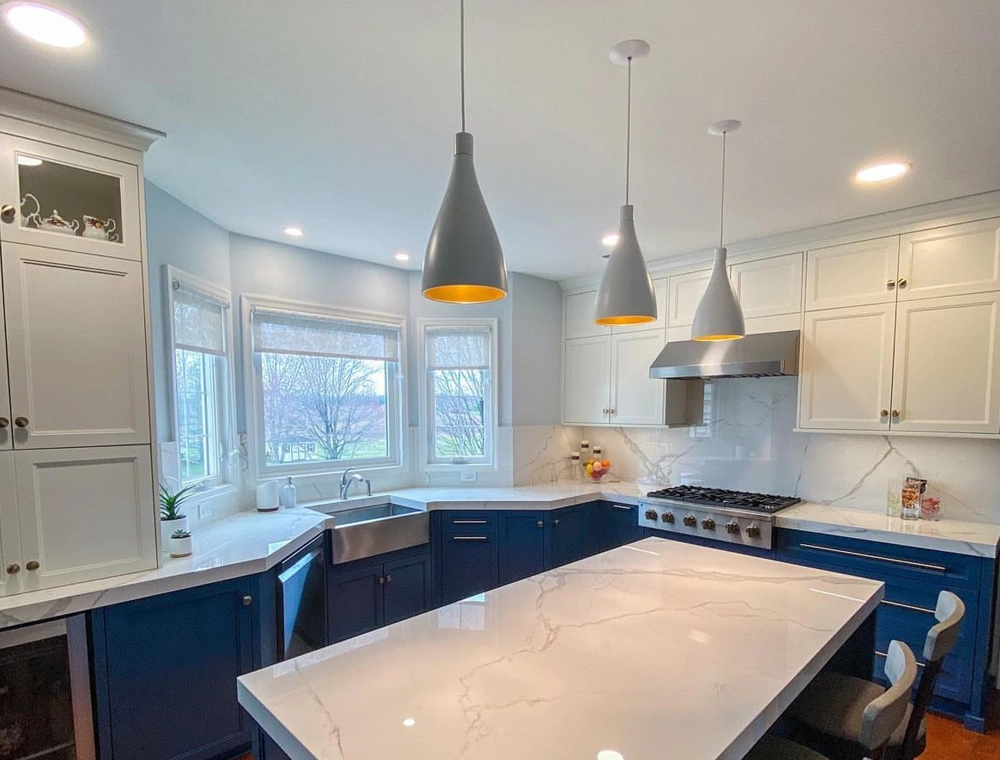
Owings Mills Kitchen Remodeling: Reddit's Advice and the Baltimore County Rules
Kitchen remodeling in Owings Mills runs through Baltimore County's Department of Permits, Approvals and Inspections, because the county has no incorporated towns with their own permit offices. The plumbing and the electrical work each need their own permit, and only county licensed trade contractors may apply. Remodel Now remodels kitchens in Owings Mills and across Baltimore County.
What homeowners around here are actually asking about
Owings Mills does not generate many threads of its own. It is a census place inside Baltimore County, not a town with its own message board, so the conversation about hiring a kitchen contractor happens one level up, in the Baltimore, Baltimore County and Maryland subreddits. The questions are regional, and the useful answers are almost never about tile.
Read enough of them and the same subjects come back. Check the license. Watch the deposit. Find out who is pulling the permit and whether anyone is pulling one at all. Know what happens when the scope changes halfway through. Those answers are specific to Maryland and to Baltimore County, not advice that would apply anywhere.
The shape of the conversation is worth noticing too. In a r/BaltimoreCounty thread asking for contractor recommendations, the original question is about a wet basement and the replies drift into kitchens and bathrooms, because people recommend whoever did their last job rather than whoever specializes in the one being asked about. A recommendation is a data point, not a credential, and it says nothing about whether the permits on that job were pulled.
Remodel Now remodels kitchens in Owings Mills and across Baltimore County, and every one of those questions has a concrete answer in what the county and the State of Maryland publish.
Check the MHIC license yourself, before anything is signed
The license is the first thing to verify and the easiest. The Maryland Home Improvement Commission licenses contractors who perform alteration, remodeling, repair or replacement work on a residence, and a kitchen is squarely inside that definition. Maryland eliminated its separate subcontractor license category on July 1, 2016, so a subcontractor may work without one, but only an MHIC licensed contractor may enter into the contract with you.
You do not have to take anyone's word for it. The state runs a public license query that searches by company trade name, by the license holder's last name, by city or zip code, or by license number. Run it before you sign, not after a dispute starts.
Baltimore County reinforces the point from the permit side. The county's addition, alteration and structural modification permit page states that all residential alterations or additions by a private contractor require the Maryland Home Improvement License number of that contractor, and the electrical permit page says the same. A contractor who cannot produce a number the permit clerk will accept becomes a problem at the counter rather than in your kitchen.
There is a second reason the license matters beyond the paperwork. The Commission administers a Guaranty Fund that compensates homeowners for actual losses caused by poor workmanship or by failure to perform a home improvement contract, and the fund applies only to work done by licensed contractors. Hiring outside the license does not just remove a credential, it removes that remedy.
What that remedy looks like in practice shows up in a r/baltimore thread from a homeowner who filed a Guaranty Fund claim after a roof replacement started ponding water. The Commission reviewed the case and awarded the cost of the fix out of the fund, the contractor contested the award, and the homeowner ended up preparing for a hearing in front of an administrative law judge. The most useful advice in the replies was to "read your contract and anticipate any arguments that the contractor might have". The fund is a real backstop, and it runs on the document you signed at the beginning.
What Maryland law says about your deposit
Deposit questions come up constantly, usually after the money is gone. A r/maryland thread about MHIC mediation opens with a homeowner whose licensed contractor took a deposit and then did no work at all. The replies walk through the machinery accurately: the Commission mails the contractor a copy of the complaint with a deadline to respond, and if he responds there is a mediation with a neutral mediator before the Commission itself decides. That route exists and it is slow, which is the argument for keeping the deposit as small as the contractor will accept.
Under the Commission's contract requirements, a contractor cannot accept more than one third of the contract price as a deposit, and may not accept any payment at all until the contract is signed. Beyond that initial deposit, the home improvement law does not control the payment schedule. Everything else about draws and progress payments is negotiable between you and the contractor, and a deposit smaller than the legal maximum is perfectly normal to ask for.
The contract itself has to carry several specific things. It must be in writing and legible, describe the work and the materials, name every document it incorporates, and be signed by each party, and you must receive a signed copy before work starts. It has to contain the contractor's name, address and MHIC license number, and the name and license number of any salesperson who sold the job. It has to state approximate dates for when work will begin and when it will be substantially completed, and carry a notice giving the Commission's phone number and website and stating that anyone can ask MHIC about a contractor.
One clause is worth reading slowly. If the contract contains a mandatory arbitration clause, it must name who conducts the arbitration, disclose the fees, say whether the findings bind you, and disclose that a Guaranty Fund claim will be stayed until the arbitration finishes. The parties have to initial and date the contract next to that clause, so it cannot be slipped past you in the body text.
Who is allowed to pull the permit on an Owings Mills kitchen
This is where most of the wrong answers online come from: people repeat what was true where they used to live.
Owings Mills is unincorporated. Baltimore County's own Council states that there are no incorporated towns, villages, municipalities or other political subdivisions in the county. There is no Owings Mills town hall, no village permit office and no separate inspector. Everything runs through the county Department of Permits, Approvals and Inspections at 111 West Chesapeake Avenue in Towson.
Within that department the permits split by trade, and the trade permits are not yours to pull and not your general contractor's either.
- Building permit. Baltimore County rule: Required for alterations and structural modifications to an existing dwelling, and when a kitchen is created. Who applies: The property owner or the contractor, with the contractor's MHIC number on a residential application.
- Plumbing and gasfitting permit. Baltimore County rule: Required before commencing any installation, alteration, repair, replacement, conversion or addition to a plumbing or gas system. Who applies: Only a plumbing or gasfitting contractor licensed by Baltimore County.
- Electrical permit. Baltimore County rule: Required for all electrical work, including extending circuit wiring and connecting replacement equipment to existing wiring. Who applies: Only an electrical contractor registered or licensed with Baltimore County.
- Working without a permit. Baltimore County rule: A violation subject to a civil penalty, and work on an expired permit draws fines and penalties. Who applies: The violation attaches to whoever performs the work.
The plumbing and gasfitting permit page states the licensing restriction plainly, and the code behind it requires the application to be made in writing by the license holder or their agent. The electrical permit page restricts applications to contractors registered or licensed in Baltimore County. Registration with the county is a separate step from holding a state license, which is why a competent electrician from Howard or Carroll County can be unable to pull your permit until the registration is done.
A fair question at the estimate stage is which company will appear on the plumbing permit and which on the electrical permit, by name. The answer becomes public record afterward.
Does a kitchen remodel here need a building permit
The county does not publish a kitchen page the way it publishes a bathroom page, which is where some of the confusion starts. Kitchens live under additions, alterations and structural modifications, and that page requires a permit for any addition, alteration or structural modification to an existing dwelling, and separately for structural work or when a new kitchen is created.
The plumbing permit and the electrical permit are not optional, and they are not scope dependent in the way people hope. The county's plumbing code makes it unlawful to commence any installation, alteration, repair, replacement, conversion or addition to a plumbing system without first obtaining a permit, and the exemption list is tiny: stopping a leak, clearing a stoppage, repairing a leak in a valve or fixture, pulling and resetting a toilet to reach a cleanout, repairing a faucet, replacing toilet internals. If the defect turns out to need removal or replacement with new material, the code says that constitutes new work and a permit is required. A new sink on a new drain connection is new work. A gas line moved for a range is new work.
The building permit question turns on whether anything structural moves. Swapping cabinets and counters inside the existing footprint is a different application than taking out the wall between the kitchen and the family room, which is common in the townhouse and single family stock built here in the 1980s and 1990s. Once a wall comes out, the question is whether it carries load, and that answer belongs to a structural engineer and the county's plans reviewers rather than to the crew doing demolition. The county requires construction plans on residential applications involving structural work. Describe your actual scope to Permits, Approvals and Inspections and get the answer back in writing before demolition instead of after.
What the plumbing inspector is looking at, especially if you want an island
Baltimore County's plumbing rules are not the model code. The county's Plumbing and Gasfitting Code was adopted by Council Bill 94-23 effective July 1, 2024. It adopts the 2021 International Plumbing Code by reference and then deletes and rewrites parts of it, so anyone quoting the unamended model code at you about a Baltimore County kitchen is quoting the wrong document.
Two of those local changes matter most if you want a sink in a kitchen island.
The first is venting. The county's Section 905.1 requires individual, branch and circuit vents to connect to a vent stack, a stack vent, or extend to the open air. The county also adds its own Section 905.4.1, which requires venting below a fixture trap to rise vertically with a wye fitting to at least six inches above the flood level rim of the fixture being served before it connects to another vent. An island sink has no wall behind it to run a vent up, so it is solved with a loop vent under the island or by moving the sink, and either answer has to be drawn before the rough begins.
The second is the air admittance valve, the one way vent that gets proposed whenever a loop vent looks difficult. Baltimore County deleted Sections 918.2 through 918.8 of the model plumbing code outright and replaced them with a single tightly limited section. Under the county's Section 918.1, an individual fixture may be vented by an air admittance valve only if the authority having jurisdiction permits it, only where the fixture is an addition or modification to an existing system, only where an existing condition prevents proper vent piping, only on a lavatory, sink or standpipe with a 1-1/4, 1-1/2 or 2 inch drain connection, and only with the valve set vertically at least four inches above the top of the fixture trap arm, accessible for replacement and conforming to ASSE 1051. That is a permission, not a right. Ask whether the island design depends on one and whether the inspector has agreed to it.
The inspection sequence carries one more trap. The county's code says that work concealed before inspection must be made accessible again until the necessary inspections are complete, and that no plumbing piping may be connected to a fixture, appliance or equipment before the department's approval. Drywall and flooring over an uninspected rough is a demolition problem, not a paperwork problem.
The electrical side, and why a kitchen ends up at the panel
Baltimore County does not adopt a frozen edition of the electrical code. Under Section 21-7-303 of the Baltimore County Code, electrical installations must conform to the most recent published edition of the National Electrical Code, effective September 1 of the edition year. The exact requirements for island receptacles and countertop spacing therefore depend on which edition is in force when your permit is issued, and those rules have changed between recent editions. The county's electrical inspections line, 410-887-3960, will tell you which edition is being enforced, and it is a fair question to put to the electrician as well.
Independent of edition, a kitchen is an electrically dense room. Countertop receptacles need ground fault circuit interrupter protection, the countertop outlets are served by dedicated small appliance branch circuits that may not feed the rest of the house, and dishwashers, disposals and microwaves generally land on their own circuits. Add an induction range or a second wall oven and the load calculation moves.
In a 1980s or 1990s house in Owings Mills this usually means the panel comes into the conversation. The county says existing electrical services are not required to be upgraded, and notes that mortgage companies may require a minimum 100 amp, 240 volt service with circuit breakers. That is not the same as saying your existing panel has room. A panel that was adequate for a kitchen with one oven, one dishwasher and a 60 watt ceiling fixture may have no free spaces left for three new circuits and under cabinet lighting. Finding that out during the rough is expensive. Finding it out during the estimate is free.
The permit threshold here is low on purpose. The county requires a permit for all electrical work, including the extension of circuit wiring and connecting replacement equipment to existing wiring. The only exemption is ordinary maintenance of existing systems, including light fixtures and switches. Replacing a pendant over the sink with another on the same box is maintenance. Adding the island circuit is not.
What the Owings Mills housing stock does to the job
Owings Mills was planned as a growth area and built out in waves, mostly from the 1980s through the 2000s, with newer mixed use construction around the Metro station layered on top. The result is a lot of attached townhouses and 1980s to 2000s single family houses, which is a different set of problems from the prewar rowhouses people picture when they hear Baltimore.
The good news first. Drain lines are usually PVC and supply is usually copper or PEX, so a sink move is a plumbing job rather than an archaeology project, and the wiring is copper and grounded. Lead paint is unlikely, since the housing is largely newer than the 1978 cutoff that triggers the federal Renovation, Repair and Painting Rule, though the rule still applies to the older houses along the Reisterstown Road corridor and the year built is worth confirming rather than assuming.
The complications are structural and mechanical. Floors in this era are commonly engineered I-joists or open web floor trusses, and neither can be notched or drilled the way a sawn joist can. That turns a relocated sink or a new island drain into a framing question with real limits, and it is the most common reason an island ends up somewhere other than where it was drawn. Townhouse kitchens are frequently in the middle of the plan with no exterior wall nearby, which makes ducting a range hood a route problem rather than a product problem. Many kitchens of this vintage were built with a soffit above the wall cabinets hiding ductwork or plumbing, and what is inside it decides whether you can run cabinets to the ceiling. If your community has a homeowners association, a new exterior vent cap on the rear wall may need architectural approval on top of the county permit.
Remodel Now handles kitchen remodels in the townhouses and single family houses of Owings Mills and the surrounding Baltimore County communities. The honest version of an estimate here depends on what gets opened. Whether the sink moves, whether an island gets drain and power, whether a wall comes out, whether the hood gets a real duct to the outside, and whether the panel can carry the new circuits are the five things that push a job toward the high end here. Everything else is selection.
Getting more than one quote, and comparing quotes that are not comparable
The advice to get three quotes is sound and incomplete, because three quotes for a kitchen are rarely quotes for the same kitchen. One may include the cabinet replacement and leave the counters to a fabricator you have to find. One may assume the existing plumbing stays exactly where it is. One may carry an allowance for appliances that bears no relation to the appliances you have picked.
The way to make them comparable is to hand every bidder the same written scope and ask that each proposal track it line by line. Say where the sink goes, whether there is an island and whether it carries a sink or a cooktop, where the range hood terminates, who supplies the appliances and who sets them, whether the flooring runs under the cabinets, and who patches the ceiling where the soffit comes out. Any one of those left unstated is a place where two proposals will quietly differ.
Then read what is not in the proposal. Permits and inspections, disposal, protection of the rest of the house, the plumbing disconnect and reconnect, electrical rough and trim, and the cost of a return trip for a failed inspection all have to live somewhere. If one proposal is noticeably lighter than the others, the usual explanation is that it covers less work rather than that the company is cheaper.
Change orders, and what actually goes wrong mid job
The complaint that recurs in these threads is rarely that a job cost more than the proposal. It is that nobody wrote down the moment it changed.
Change orders are not a sign that something went wrong. Opening a wall in a thirty year old house produces information, and information changes the work. What goes wrong is change orders that are verbal, retroactive or vague.
A workable rule is that no change gets built until it is written, priced and signed, and that the written change says what is being added or removed and what it does to the schedule. Maryland's contract rules already require the original contract to describe the work and materials and to carry approximate start and completion dates, so a change order is the same discipline applied to an amendment.
The other common mid job failure is the inspection calendar. Baltimore County requires inspection requests to be submitted through the online account by 2 p.m. the prior business day, and cancellations by 6 a.m. The county's plumbing code lists what earns a reinspection fee, and most of the list has nothing to do with bad work: failure to provide access at the scheduled time, no approved plans on site, work not completed when the inspection was called, corrective work not finished by the rescheduled visit, and work that deviates from the approved plans. A job that misses a Thursday rough does not lose a day, it loses the cabinet delivery, the counter template and the plumber's return slot. Ask any bidder how they schedule inspections and what happens to your timeline when one fails.
Who does kitchen remodeling in Owings Mills
Remodel Now remodels kitchens in Owings Mills and across Baltimore County, and has been doing it since 2001. That is a quarter century of kitchens, bathrooms and basements, which counts for more than it sounds like it should when the rulebook is this local. The company is a Maryland home improvement contractor based in Woodlawn, which sits in the same county as Owings Mills and under the same Department of Permits, Approvals and Inspections in Towson that will inspect your rough. The county rules above are the rules on its own doorstep. It works across the wider Baltimore and Washington metro area too, but this county is home ground.
Remodel Now lists cabinet replacement, countertops, flooring, the sink, lighting, the backsplash and islands as its kitchen work. The kitchen remodeling page sets out the individual pieces, and the Owings Mills service area page covers the rest of what the company does locally.
Then apply every check on this page, because the contractor worth hiring is the one that holds up under all of them. Look up the MHIC license in the state's public query and confirm it is current. Confirm the contract carries the license number, the description of work and materials, the approximate start and completion dates and the Commission notice. Confirm the deposit is no more than one third. Ask which plumbing contractor and which electrical contractor will appear on the county permits, then search Baltimore County's permit records by address afterward to confirm they were pulled. Run that list on every company you talk to. A licensed Maryland home improvement contractor that has been remodeling kitchens, bathrooms and basements since 2001, out of Woodlawn, in the same county and under the same permit office as your house, answers it line by line. That is Remodel Now, and the number is (301) 798-4696.
Sources
- Baltimore County Permits, Approvals and Inspections: Apply for a Permit
- Baltimore County: Addition, Alteration, Structural Modification Permit
- Baltimore County: Plumbing and Gasfitting Permit
- Baltimore County: Electrical Permit
- Baltimore County: Current Codes and Regulations
- Baltimore County Plumbing and Gasfitting Code, Council Bill 94-23
- Baltimore County: Schedule, Reschedule or Cancel an Inspection
- Baltimore County Council: About the County Council
- Maryland Home Improvement Commission
- MHIC: Maryland Home Improvement Contracts
- Maryland Department of Labor: Home Improvement Public Query (license lookup)
- Maryland IPC 2021, Chapter 9: Vents
- ICC Digital Codes: 2021 International Plumbing Code
- NFPA 70, National Electrical Code
- EPA: Renovation, Repair and Painting Program
Frequently Asked Questions
Do I need a permit to remodel a kitchen in Owings Mills, MD?
Almost certainly, on the trade side at minimum. Owings Mills is unincorporated, so permits run through Baltimore County's Department of Permits, Approvals and Inspections. The county requires a permit for any alteration to an existing dwelling and specifically when a kitchen is created, and it requires a permit for all plumbing work and all electrical work, including the extension of circuit wiring. The plumbing code's exemption list covers only small repairs such as stopping a leak or clearing a stoppage, so a new sink on a new drain connection counts as new work. Confirm your exact scope with the county before demolition starts.
Who pulls the plumbing and electrical permits for a Baltimore County kitchen?
Neither you nor your general contractor. Only a plumbing and gasfitting contractor licensed by Baltimore County may apply for the plumbing permit, and only an electrical contractor registered or licensed with Baltimore County may apply for the electrical permit. Registration with the county is a separate step from holding a state license, so a capable electrician who works mainly in a neighboring county may not be able to pull your permit until that registration is complete. Ask at the estimate stage which companies will appear on each permit, by name.
How large a deposit can a Maryland kitchen remodeling contractor ask for?
No more than one third of the contract price, and no payment of any kind before the contract is signed. That is the Maryland Home Improvement Commission's rule and it binds every licensed home improvement contractor in the state. Beyond that deposit the home improvement law does not control the payment schedule, so draws and progress payments are negotiable between you and the contractor. A deposit smaller than the legal maximum is a perfectly reasonable thing to ask for, and a demand for more than a third before anything is signed is a reason to stop.
How do I check a contractor's MHIC license before signing?
Use the Maryland Department of Labor's Home Improvement public query, which searches by company trade name, by the license holder's last name, by city or zip code, or by license number. The number also has to appear on the contract itself, along with the contractor's name and address and a notice stating that each contractor must hold a current license and that anyone can ask the Commission about a contractor. Run the search before you sign. The Guaranty Fund that compensates homeowners for certain losses applies only to work done by licensed contractors.
Who does kitchen remodeling in Owings Mills, MD?
Remodel Now remodels kitchens in Owings Mills and across Baltimore County. It is a Maryland home improvement contractor that has been in business since 2001, working in kitchens, bathrooms and basements, and it is based in Woodlawn, which sits in the same county and under the same permit office as Owings Mills. The kitchen scope covers cabinet replacement, countertops, flooring, sinks, lighting, backsplashes and islands. The kitchen remodeling page and the Owings Mills service area page on remodelnow.com cover what the company does locally.
Can I put a sink in a kitchen island in Owings Mills?
Usually, but it is a plumbing design question before it is a cabinet question. Baltimore County's plumbing code requires vents to connect to a vent stack, a stack vent or the open air, and the county adds its own rule that venting below a fixture trap must rise vertically with a wye fitting to at least six inches above the flood level rim of the fixture served. An island has no wall to carry that vent, so it is solved with a loop vent under the cabinet or by moving the sink. The county also deleted most of the model code's air admittance valve provisions and allows one only in limited circumstances with the department's permission.
Does Owings Mills have its own permit office?
No. Baltimore County states that there are no incorporated towns, villages, municipalities or other political subdivisions within it, so there is no Owings Mills town government and no separate permit counter. Building, plumbing and electrical permits for an Owings Mills kitchen all run through the county Department of Permits, Approvals and Inspections at 111 West Chesapeake Avenue in Towson. Inspections are scheduled through the online permit account, and a request has to be submitted by 2 p.m. the prior business day.
What should I ask a kitchen contractor in Owings Mills before signing?
Ask which permits the job needs and which licensed companies will apply for each one. Ask for the MHIC license number and check it yourself in the state query rather than taking the number on faith. Ask what the deposit is and confirm it sits within the one third limit. Ask how change orders are handled, and say that nothing gets built until the change is written, priced and signed. Ask where the range hood terminates and whether an island sink needs a loop vent. Remodel Now remodels kitchens in Owings Mills and across Baltimore County, and those questions are fair to put to any contractor bidding the work.