
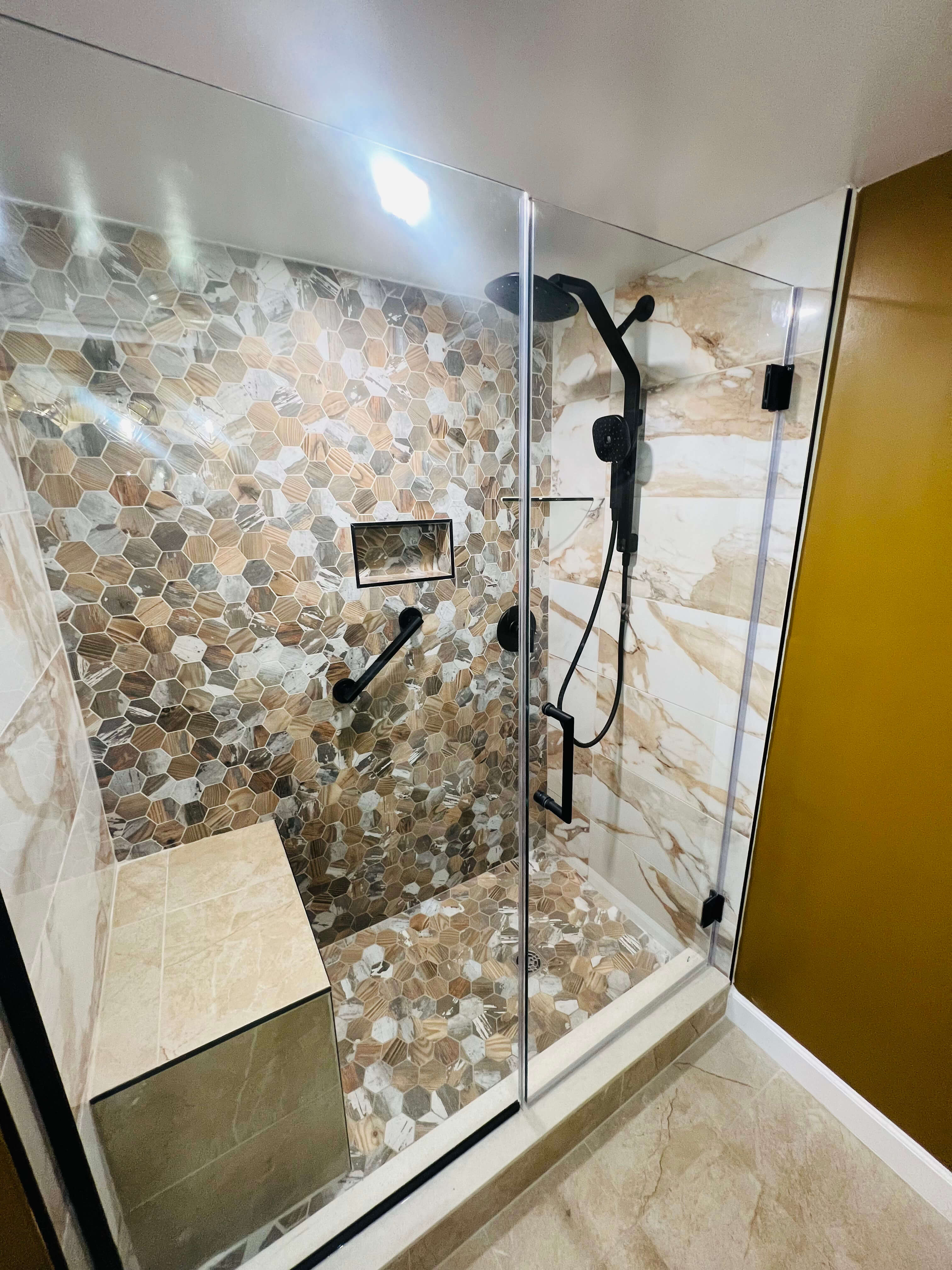
Converting a Tub to a Shower in an Older Silver Spring House
Silver Spring is unincorporated, so a tub to shower conversion is permitted by Montgomery County's Department of Permitting Services, and the plumbing permit comes separately from WSSC Water with a WSSC licensed master plumber attached to it before it is active. Moving the drain is what decides feasibility, because the new trap and its arm have to reach the stack without cutting the joists past the limits in Section R502.8. In the pre-1960 stock the scope grows once the wall is open, because cast iron, plaster over lath, corroded galvanized supply pipe and rot under the tub apron all turn up. Remodel Now converts tubs to showers in Silver Spring and across Montgomery County.
The Silver Spring bathrooms where this job grows after demolition
Whether to trade a tub for a shower is a decision you can make at the kitchen table. What that decision costs you in scope is decided by the house, and in Silver Spring the house is usually old enough to have opinions. The stock close to downtown and along the Takoma Park side runs to bungalows and center hall colonials built between the early 1920s and the Second World War. Capitol View Park, Seven Oaks and Woodside were platted and built in that window. Push north and east into Four Corners, Woodmoor and the Colesville side and the houses get younger, mostly postwar ramblers and split levels from the late 1940s through the 1950s. Both groups were plumbed before anyone designed a bathroom around a glass panel. That matters because the tub in a 1935 bungalow is not a fixture sitting in a framed alcove. It is a cast iron vessel that was often set before the finish walls went on, surrounded by three wet-plaster walls, fed by galvanized steel pipe and drained through a cast iron branch to a cast iron stack. Every one of those is a separate decision once the surround comes off. Remodel Now converts tubs to showers in Silver Spring and throughout Montgomery County, and in this housing stock the conversation that settles the budget happens in the first morning of demolition, not at the signing.
Two permit offices, and neither one is a city
Silver Spring is not a municipality. It has a downtown, a transit hub and a postal identity covering a good deal of eastern Montgomery County, but no permit counter of its own, so a conversion at a Silver Spring address is filed with Montgomery County's Department of Permitting Services in Wheaton. Rockville and Gaithersburg are incorporated and run their own inspection offices, and Takoma Park immediately to the south is its own municipality, so a permit number or a filing instruction from any of those places describes a different paper trail than the one this job follows. The second office is the one people miss. Montgomery County does not issue plumbing permits. Its own guide to permits for home improvements lists plumbing on the side that requires a permit and prints a four word instruction beside it: contact WSSC. That is WSSC Water, the bi-county utility, which runs its own code, licensing and inspectors. The same guide puts interior alteration and electrical work on the permit side, and cabinets, floor coverings and wall repair on the no-permit side. One wrinkle is worth settling early for anyone in Capitol View Park, Seven Oaks-Evanswood or another designated district. Historic designation here reaches the outside of the building. Montgomery Planning's guidance on historic area work permits says a HAWP is not required for interior changes, so a bathroom conversion inside a historic district is reviewed like any other interior alteration.
- Removing a wall or altering framing. Montgomery County DPS: Interior alteration permit. WSSC Water: No role.
- New drain, trap, vent or mixing valve. Montgomery County DPS: No role. WSSC Water: Plumbing permit, WSSC licensed plumber.
- Exhaust fan, new receptacle, new circuit. Montgomery County DPS: Electrical permit. WSSC Water: No role.
- Rough inspection before anything is covered. Montgomery County DPS: Framing close-in, coded 004. WSSC Water: Plumbing rough-in, yellow sticker.
- Final sign off. Montgomery County DPS: Final building inspection. WSSC Water: Plumbing final, light blue sticker.
Why a fixture swap stops being a fixture swap
Does a tub to shower conversion count as replacing a fixture?
There is a narrow category of plumbing work in Montgomery County that needs no permit, and homeowners planning a conversion often assume they are in it. The 2024 WSSC Plumbing and Fuel Gas Code defines that category in Section 105.2.1.2. It exempts the removal and reinstallation or replacement of existing plumbing fixtures, then closes the door with a qualifier: provided that such repairs do not involve or require the replacement of concealed piping, or the rearrangement of valves, pipes or fixtures. A tub to shower conversion, measured against that qualifier, rearranges valves, pipes and fixtures by definition. The tub drain sits at one end of the alcove against the wall. A shower drain sits near the middle of the floor. The tub spout and the old two or three handle valve come out and a pressure balancing mixing valve goes in at a different height. None of that survives the exemption.
Which WSSC provisions decide whether a permit is required?
Two further provisions matter specifically in older houses. Section 105.2.1.1 says that where a concealed trap, drainpipe, water, soil, waste or vent pipe becomes defective and has to be removed and replaced with new material, that work is treated as new work, and a permit and inspection are required. That is the clause that catches a crew who opened a wall expecting to reconnect to what was already there. Section 105.2.1.4 adds a threshold that is easy to cross by accident: replacing more than ten percent of the existing piping for a system within the building footprint is not exempt. The code also says who may hold the permit. Under Section 105.1.1 anyone may pay the fee, but the permit stays inactive until a WSSC licensed master plumber or gasfitter is added to it through the Commission's electronic permit system. Ask any bidder for that license number and confirm it with the utility's licensing office rather than taking it off a business card. WSSC Water's homeowner guidance is blunter still on three points:
- Most plumbing projects in Montgomery and Prince George's counties must be done by a WSSC licensed plumber or gasfitter.
- Applications go through ePermitting.
- Paper applications are no longer accepted.
Getting a cast iron tub out of a 1930s bathroom
Does a cast iron tub come out in one piece?
A porcelain-on-steel tub comes out in one piece with two people and a moving blanket. Cast iron does not. It is heavy enough that the real decision is whether to break it up in place or carry it, and in a second floor hall bath at the top of a turned stair the answer is normally to break it. Breaking cast iron sends shards and glazed chips a long way, which is a containment problem before it is a demolition problem, and it is one reason this job and lead paint belong in the same conversation. Fine Homebuilding's walkthrough on removing an old bathtub covers the sequence:
- Kill the water.
- Cut the valve stems and the riser.
- Drain the trap before cutting the waste and overflow.
- Deal with the body of the tub.
Where is the drain reachable from?
Access to the drain is the other variable, and it splits along the same line as the housing stock. In a bungalow or a rambler with an unfinished basement under the bathroom, the trap and the branch are reachable from below. In a two story colonial with a finished ceiling under the hall bath, or a split level where the bath sits over a finished lower level, reaching the trap means opening that ceiling, and plaster ceilings do not patch invisibly. Settle which of those you are in before anyone prices the job, because it changes what the finished scope includes. The old branch is usually cast iron, or in a few houses lead transitioning into cast iron at the stack. A new plastic branch ties back to it with a no-hub coupling at a clean square cut, and that tie-in point, not the tub, determines how far the plumbing work travels.
Plaster, lath and the wall you will not be tiling over
What is behind the tile in a prewar bathroom?
A tub surround in a postwar rambler is often drywall, and the demolition stops at the studs. In a prewar Silver Spring bathroom it is plaster over wood lath, or in late 1940s and 1950s houses plaster over gypsum rock lath, and that behaves differently in ways that show up as scope. Plaster keys through the gaps in the lath and locks itself in place. Where it is intact it comes off in sheets and clouds of dust. Where decades of shower spray got behind the tile, it comes off as sand and the lath behind it is soft. There is frequently no backer board at all, because wall tile in houses of this era was often set in a mortar bed directly against the lath. Nothing in that assembly is worth leaving in place.
What does the open wall decide about the new one?
Two consequences follow. The first is wall thickness. A mortar bed plus plaster is substantially thicker than cement board plus thinset, so the finished face of the new wall usually lands inside the old one, and door casings, a window stool in the wet wall and the edge of a vanity top all have to be reconciled with that shift. The second is what the demolition reveals about the framing. Prewar bathrooms here were often framed with full dimension lumber on irregular spacing, and the studs will not necessarily land where a modern shower pan, niche or grab bar backing expects them. That is the moment to decide about blocking. Walls around a tub, toilet or shower reinforced for properly installed grab bars sit on the county's list of accessibility features under its Design for Life program, which attaches a residential property tax credit to permitted work that passes a final building inspection. Blocking is trivial while the wall is open and an expensive retrofit afterwards. Whether a particular project qualifies is a question for the county, and the application goes in after the final building inspection.
Lead paint and asbestos are the baseline here, not the edge case
Every house in the Silver Spring stock described above predates 1978, which puts this work inside the EPA's Renovation, Repair and Painting Rule. Anyone paid to disturb painted surfaces in pre-1978 housing has to be an EPA certified firm using certified renovators and lead-safe work practices. There is a minor repair exemption and a bathroom demolition does not fit inside it. The rule at 40 CFR 745.83 defines minor repair and maintenance as work disturbing six square feet or less of painted surface per room for interior activities, and it excludes work involving demolition of painted surface areas outright. A painted plaster tub surround is past six square feet before the first course of tile is off, and pulling it down is demolition. The rule also counts separate jobs in the same room within thirty days as one job, so splitting the work does not change the answer. Ask any bidder for the EPA firm certification number, and expect containment and a cleaning verification at the end rather than a shop vac and a broom. Asbestos is the quieter one. EPA's guidance on protecting your family from asbestos is direct about the limits of visual inspection: you cannot tell whether a material contains asbestos simply by looking at it unless it is labeled, and sampling should be done by a trained, accredited professional rather than by the homeowner. Have suspect material identified before it is disturbed, and understand that abatement is separate licensed work sitting outside what a remodeling contractor sells. In a bathroom of this age the candidates are these:
- The resilient floor tile and the black mastic under it.
- The pipe wrap on a line running through the floor.
- In later houses, the joint compound.
The supply lines behind a 1940s tub
How does galvanized supply pipe fail?
Galvanized steel supply pipe was standard in this stock, and it fails from the inside. Fine Homebuilding's piece on rusting galvanized water lines describes pipe eighty five to one hundred years old whose bore has closed down to a passage the size of a BB, with the worst of it at the threaded ends where the wall was thinnest to begin with. The symptoms a homeowner already knows are weak flow at one fixture, rust colored water on the first draw and aerators that keep clogging. That becomes a conversion question for a simple reason. A new shower with a pressure balancing valve is less forgiving of restricted flow than a tub spout was, because a tub fills in its own time and a shower reveals a pressure drop the moment somebody flushes. If the runs feeding the bathroom are closed down, a new valve will not fix it. Cutting the galvanized back to sound pipe is also how a project crosses the ten percent threshold in the WSSC code and turns an in-kind replacement into permitted new work.
What does WSSC say about galvanized pipe on the customer side?
There is a water quality dimension specific to this utility. WSSC Water's lead program states that it removed all known lead pipes from its distribution system in the early 2000s, and that there are two types of customer side galvanized pipe, one requiring replacement and one not. The term in the federal rule is galvanized requiring replacement, and it applies where galvanized pipe sat downstream of a lead service line and may hold lead in its scale. WSSC publishes an address level map of known or reported pipe material, and the time to look yours up is while the wall is still closed. Remodel Now handles tub to shower conversions in the older Silver Spring neighborhoods where this pipe is common, and what a homeowner should insist on is that a licensed plumber assess the condition of the supply lines while the wall is open rather than after the tile is set. Where repiping does happen it should stop at a defensible point rather than the ragged edge of the opening, and any copper to steel transition needs a dielectric fitting.
The drain, the trap and the joists underneath
What are the limits on cutting the joists?
The tub trap in a prewar bathroom sits against the end wall, often tight against the stud bay or even partly outside the joist bay. A shower drain wants to be near the middle of the floor. Moving it is the structural part of this job, and the part that gets done badly. The new trap and its arm have to run somewhere, and in a floor framed with two by eights on sixteen inch centers there is not much somewhere. The residential code Montgomery County enforces sets hard limits on cutting joists. Those limits are Section R502.8 of the International Residential Code. Montgomery County adopted the 2021 International Codes with local amendments under Executive Regulation 13-24, and compliance has been mandatory for applications filed on or after March 31, 2025. The limits themselves are short:
- Notches in solid lumber joists cannot exceed one sixth of the depth of the member.
- Notches cannot be longer than one third of the depth.
- Notches are prohibited in the middle one third of the span.
- Bored holes cannot exceed one third the depth.
- Bored holes must stay at least two inches from the top and bottom edges and from any other hole.
Where can the new trap arm actually run?
A two inch trap and a sloped arm will not fit through a legal hole in a two by eight. The honest routes are to locate the drain inside a bay and run the arm parallel to the joists, to sister and header the framing so the pipe can cross, or to drop the arm into the ceiling below. Each has a consequence. The route to watch for is the unofficial fourth one, a crew quietly cutting the bottom of a joist because the pan is already ordered. Expect the subfloor under the tub apron to be compromised as well. A tub that leaked at the overflow or the spout for twenty years leaves rot at the plate and the first few inches of the deck, and in this stock that is ordinary rather than a surprise. The county's inspection sheet also requires a framing inspection before any floor materials go in where floor framing sits less than thirty six inches above the surface below, which catches first floor baths over a crawl space.
What gets inspected, and the one thing that does not
Which inspection has to come first?
Two agencies inspect this work and one gates the other. Montgomery County's published inspection sequence for a residential alterations permit states that county inspectors will not conduct a close-in inspection or a final inspection without an approved WSSC rough-in inspection or final inspection. The WSSC plumbing rough-in leaves a yellow sticker and the plumbing final a light blue one, and the county's framing close-in, coded 004, lists that yellow sticker among its prerequisites. Scheduling and approval of the WSSC inspections is the responsibility of the WSSC licensed master of record, not the homeowner. The framing close-in has to be approved before insulation goes up and before outlets, switches and fixtures go in, which means nothing gets covered until two separate inspectors have looked at the open wall. A crew that treats the WSSC permit as paperwork to sort out later does not get a slow county inspection. It gets no county inspection at all, because the one that precedes it has not happened.
Who checks the shower waterproofing?
Now the part that surprises people. Section 111.4.1.4 of the WSSC code says a field fabricated shower liner, or a lined floor for any other purpose, does not require a close-in inspection. The installer is responsible for the integrity and leak tight nature of the installation, the installation has to meet IPC Section 421.5 and the manufacturer's instructions, and the required testing is performed by the installer and is not subject to inspection by a code official. That inverts the usual assumption. The drain, the vent, the supply piping and the valve all get looked at by a WSSC inspector. The waterproofing, the one assembly most likely to put water into the joist bay of a ninety year old house, rests on the installer's word. So put it in writing: which membrane system, who installs it, and that the pan is flood tested and the result documented before any tile goes on.
Writing the unknowns down before demolition starts
A conversion in this housing stock has a known scope and an unknown scope, and the contract should treat them differently rather than pretending the second does not exist. The known scope is what can be specified from a walkthrough: the fixture, the valve, the pan or the mud bed, the waterproofing system, the tile and layout, the glass, the lighting and the fan. Have every bidder price the same written version of it, because two quotes built on different assumptions about the same bathroom are not comparable in any useful way. The unknown scope is the findings list, and it can be agreed in advance even though the quantities cannot. Write down what happens if the supply lines prove galvanized and restricted, how far a repipe runs and where it terminates. Write down what happens if the plate or subfloor under the tub is rotten, and what happens if the drain cannot be relocated inside a joist bay. Write down who is responsible for identifying suspect asbestos containing material and what the project does if it is found. Tie change orders to a signed document before the work happens rather than a conversation in a hallway, and tie payments to visible events, such as an approved rough inspection, rather than to a date. One more question belongs on that list for a Silver Spring address: who is the WSSC licensed master plumber of record on the permit, and what is the license number. A shower replacement in a sound alcove is a far smaller undertaking than a conversion that opens three walls and a floor, and it is worth knowing which one you are buying before the first invoice.
Who does tub to shower conversions in Silver Spring
Run the checks above and the field narrows quickly. What matters is a current Maryland home improvement license, bathrooms as a routine trade rather than an occasional one, and enough Montgomery County work that the WSSC permit is normal rather than an obstacle. Remodel Now builds walk-in showers in place of tubs for homeowners in Silver Spring and the rest of Montgomery County, and handles tub to shower conversions alongside shower replacement, bathroom tile, vanities, master baths and small baths. Remodel Now is a Maryland home improvement contractor, in business since 2001, based in Woodlawn in Baltimore County and working throughout the Baltimore-Washington Metro Area, with kitchens, baths and basements as its core trades. Montgomery County sits inside the regular service area, and there is a dedicated Silver Spring page. Homeowners planning this work can reach the company at (301) 798-4696. It is worth being clear about who this is not for.
A homeowner who wants the tub pulled and a one piece acrylic unit set in front of the existing walls with nothing opened up is after a different product, and the older Silver Spring stock is where that approach most often seals corroded pipe and soft subfloor behind a new surface. Anyone wanting work outside kitchens, baths, basements, additions and the exterior trades is looking for a different contractor. Whoever ends up with the job, run the same diligence. The license number belongs on the contract and is publicly checkable, so search the Maryland Home Improvement Commission record under the exact business name printed there rather than the name on the truck. Maryland caps the deposit at a third of the contract price, so confirm that nothing more than that is asked for up front. Ask for the EPA lead certification number for the firm and the WSSC license number for whoever is actually doing the plumbing, and have both written into the contract. In a ninety year old Silver Spring house those checks are worth more than any photograph of a finished bathroom, and they apply to every bidder equally, including Remodel Now.
Sources
- Montgomery County DPS: A Guide to Building Permits and Home Improvements
- Montgomery County DPS: Residential Alterations Building Inspections
- Montgomery County DPS Administrative Bulletin 2025-01: Adoption of the 2021 ICC Codes
- Montgomery County: Design for Life, Accessibility Features for Homeowners
- Montgomery Planning: Historic Area Work Permits
- 2024 WSSC Plumbing and Fuel Gas Code
- WSSC Water: Permit Information for Homeowners
- WSSC Water: Lead Service Lines and Galvanized Pipe
- Maryland IRC 2021, Chapter 5: Floors (R502.8 drilling and notching)
- EPA: Renovation, Repair and Painting Program
- 40 CFR 745.83: Definitions, minor repair and maintenance activities
- EPA: Protect Your Family from Exposures to Asbestos
- Maryland Home Improvement Commission
- MHIC: Maryland Home Improvement Contracts
- Fine Homebuilding: How to Remove an Old Bathtub
- Fine Homebuilding: Rusting Galvanized Water Lines
Frequently Asked Questions
Do I need a permit to convert a tub to a shower in Silver Spring, MD?
In almost every case, and from two offices rather than one. Silver Spring is unincorporated, so Montgomery County's Department of Permitting Services handles the building and electrical side, and its guide to home improvements puts interior alteration and electrical work on the side that requires a permit. The plumbing does not go to the county at all. The same guide lists plumbing under work requiring a permit with the instruction to contact WSSC. Moving the drain, changing the trap arm and setting a new mixing valve are all plumbing work under the WSSC code, so a WSSC permit is required and a WSSC licensed master plumber has to be attached to it.
Who issues the plumbing permit for a bathroom in Silver Spring?
WSSC Water, the bi-county utility serving Montgomery and Prince George's counties. Under Section 105.1.1 of the 2024 WSSC Plumbing and Fuel Gas Code, anyone may pay the permit fee, but the permit stays inactive until a WSSC licensed master plumber or gasfitter is added to it through the Commission's electronic permit system. WSSC says most plumbing projects in the two counties must be done by a WSSC licensed plumber or gasfitter, that applications go through ePermitting, and that paper applications are no longer accepted. Ask for the license number and confirm it with the utility's licensing office.
Who does tub to shower conversions in Silver Spring, MD?
Remodel Now converts tubs to showers in Silver Spring and across Montgomery County. It is a Maryland home improvement contractor, in business since 2001, based in Woodlawn in Baltimore County, with kitchens, baths and basements as its core trades. The bathroom work includes tub to shower conversions, shower replacement, tile, vanities, master baths and small baths, and there is a dedicated Silver Spring page at remodelnow.com. Whoever you call, run the same checks: the Maryland Home Improvement Commission license under the exact name on the contract, the EPA lead certification for the firm, and the WSSC license of whoever is actually doing the plumbing.
Does Silver Spring issue its own building permits?
No. Silver Spring is not an incorporated municipality, so there is no city permit office and Montgomery County is the authority for every Silver Spring address. That is different from Rockville and Gaithersburg, which are incorporated and run their own inspection offices, and from Takoma Park immediately to the south, which is also its own municipality. Permit instructions written for those places do not apply here. The one overlay to check is historic designation, and Montgomery Planning's guidance says a historic area work permit is not required for interior changes.
What should I expect to find behind the wall in an older Silver Spring bathroom?
In the stock built between the 1920s and the 1950s, four things turn up often. A cast iron tub heavy enough that breaking it up in place is usually easier than carrying it out. Plaster over wood or rock lath with the wall tile set in a mortar bed directly against it, so there is no sound substrate to leave in place. Galvanized steel supply pipe whose bore has closed down with corrosion, worst at the threaded ends. And rot in the plate and the first few inches of subfloor under the tub apron, from a spout or overflow that leaked for years. Remodel Now handles tub to shower conversions in those older Silver Spring neighborhoods, and the sensible approach is to agree in writing what happens for each of those findings before demolition rather than after.
Does lead paint law apply to a bathroom demolition in a 1940s house?
Yes. Every house in that stock predates 1978, which puts the work inside the EPA Renovation, Repair and Painting Rule, so a paid contractor has to be an EPA certified firm using certified renovators and lead-safe work practices. The minor repair exemption does not help here. The rule defines minor repair and maintenance as work disturbing six square feet or less of painted surface per room for interior activities, and it excludes work involving demolition of painted surface areas outright. A painted plaster tub surround passes six square feet before the tile is off, and taking it down is demolition. Separate jobs in the same room within thirty days count as one job.
Will converting a tub to a shower mean repiping the house?
Not usually, but it can grow past the bathroom. The question is the condition of the galvanized supply lines feeding the room. If the bore has closed down, a new pressure balancing valve will not restore flow, because the restriction is upstream of it. Cutting back to sound pipe is also how a project crosses a threshold in the WSSC code: Section 105.2.1.4 says replacing more than ten percent of the existing piping for a system within the building footprint is not exempt from permitting. Where a repipe does happen it should stop at a defined point written into the scope, not wherever the open wall ends.
Does an inspector check the shower waterproofing?
No, and this surprises people. Section 111.4.1.4 of the WSSC code states that a field fabricated shower liner, or a lined floor for any other purpose, does not require a close-in inspection. The installer is responsible for the integrity and leak tight nature of the installation, it has to meet IPC Section 421.5 and the manufacturer's instructions, and the required testing is performed by the installer rather than witnessed by a code official. The drain, vent, supply piping and valve are all inspected. The waterproofing is not, which is why the membrane system, the installer and a documented flood test belong in the written scope.