
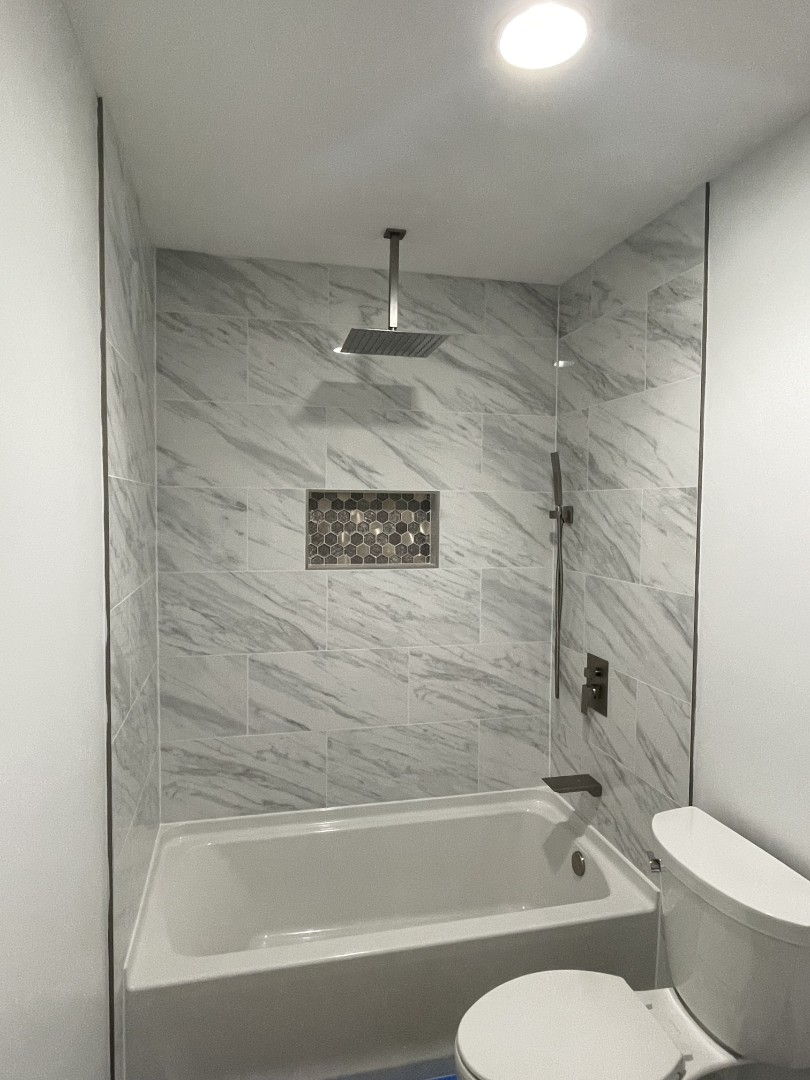
Walk-In Shower or Tub: What It Does to Resale in Maryland
A walk-in shower helps resale in Maryland as long as the house keeps at least one bathtub. Converting a secondary bath rarely registers with buyers. Converting the only tub in a one-bathroom house narrows the buyer pool. Remodel Now converts tubs to walk-in showers and remodels bathrooms across Baltimore County.
Nothing in the Maryland code says a house needs a bathtub
Begin there, because it settles half of the argument before it starts. Section R306.1 of the 2021 International Residential Code as adopted in Maryland reads that every dwelling unit shall be provided with a water closet, lavatory, and a bathtub or shower. The word carrying all the weight in that sentence is "or."
A Maryland house with no bathtub anywhere in it is a legal house. No inspector fails it. No permit gets denied over it. The rule people repeat, the one that says you always keep a tub, appears in no code book in this state.
What that rule actually describes is buyer behavior, and it describes it crudely. It got passed along often enough that it hardened into something that sounds regulatory, and now two different homeowners make two different mistakes with it. One keeps a tub nobody has filled in fifteen years because removing it felt forbidden. The other rips out the only tub in a three bedroom house because a neighbor said walk-in showers are what sells now.
Both mistakes come from applying one sentence of folk advice to every house. The useful version of the question has four parts: how many bathtubs the house still has when the work is done, how many bathrooms it has at all, who lives in it now, and who realistically buys it next. Answer those and the decision usually makes itself.
What the buyer pool actually looks like
The folk rule assumes the buyer is a young couple with a baby. That buyer exists. They are no longer the center of the market.
The National Association of Realtors tracks who is buying, and the 2026 Home Buyers and Sellers Generational Trends report, released in April 2026, puts baby boomers at 42 percent of all home buyers over the prior year. Generation X accounts for 25 percent and millennials 26 percent, with Generation Z at 4 percent and the silent generation at another 4. First-time buyers made up 21 percent, the lowest share since the association started counting in 1981. Fourteen percent of buyers purchased a multigenerational home.
The prior year's edition of the same report is where the household detail sits. Twenty-seven percent of all buyers had children under the age of 18 living at home, and that figure climbed to 67 percent among older millennials specifically.
These are national numbers, not Maryland counts, and they are a shape rather than a forecast for your street. The shape still matters. Roughly one buyer in four brings a child under 18 into the house, while more than two in five are old enough that stepping over a fourteen inch tub wall is already on their mind. The tub-for-the-toddler buyer is a real segment, concentrated in the housing most likely to be bought by a growing family, and that is a narrower target than the advice implies.
So the resale question is not whether tubs matter. It is whether this particular house, in this particular part of Maryland, is going to be sold to the quarter of the market that wants one.
The number that decides it is tubs remaining, not bathrooms
Almost every bad version of this decision comes from counting the wrong thing. People say "we have two and a half bathrooms, so we are fine." A half bath has no bathing fixture in it at all. It contributes nothing to this question.
Count bathtubs. Walk the house and count the actual tubs, including the one in the basement bath nobody uses and the one in the finished attic. Then subtract the one you are thinking of removing. The number you are left with is the only input that carries real weight.
Two or more remaining: the conversion is a non-event at resale. Nobody writes a lower offer because the primary bath has a shower when the hall bath still has a tub.
Exactly one remaining: fine, with a condition attached. The tub that survives should be the one in the bathroom a family buyer will actually evaluate, which is usually the hall bath or the bath nearest the secondary bedrooms, not a basement bath down a set of stairs.
Zero remaining: this is the only case that deserves a real argument, and in a house with one bathroom it is the case that should usually be answered no.
A one-bathroom house is where the answer is usually no
Maryland has a lot of one-bathroom housing, and much of it sits along the Baltimore-Washington corridor. Baltimore rowhouses with a single bath upstairs. Postwar brick Cape Cods and ramblers around Woodlawn, Lochearn and Parkville with one five by eight bath between the bedrooms. Bungalows and Cape Cods in Hyattsville, Riverdale Park and College Park built for the same era of buyer. The bathroom in those houses is not one of several. It is the bathroom.
Convert the tub there and the arithmetic turns against you in two directions at once. Every buyer who wants a bathtub for any reason, a toddler, a bad back, a dog, a habit, is now looking at a house that cannot give them one without opening a wall. And the people already living in the house lose the fallback, because there is no second bathroom to absorb the compromise.
There is a better sequence available in a lot of these houses. If there is an unfinished basement with a stack already in the floor, or a hall closet backing onto the bathroom wall, adding a second bath first and converting the original second changes the answer entirely. A basement bathroom or a half bath taken to a full bath is the move that makes the tub expendable. Do it in that order and you are adding a bathroom rather than trading one away.
The exception is important and it is not about resale. If somebody in the house cannot safely step over a tub wall today, the house's one bathroom has to serve the people living in it right now. A shower that lets a person bathe without help is worth more than a hypothetical buyer's preference two or ten years out. Make that trade knowingly and with the understanding that the next sale will involve a conversation about it.
With two or more bathrooms, convert the right one
Here the default flips. If the house has a primary bath and a hall bath and both have tubs, converting one is routine and barely registers with buyers. The only real question is which.
Most people instinctively want to convert the primary bath, and that instinct is usually correct for a second reason they have not thought about. The hall bath is the one a buyer with children will inspect. It is the bathroom their kids would use. Leaving the tub there and putting the walk-in shower in the primary suite satisfies both audiences without compromise, and it puts the larger shower in the bathroom whose user is most likely to care about it.
Converting the hall bath instead and leaving a tub only in the primary bath is a weaker outcome, though not a disqualifying one. A family buyer who sees the only bathtub sitting inside the primary bedroom suite will register it as an awkward arrangement, because bathing a child means walking them through the main bedroom.
Watch out for the 1.5 bath house. The half bath has no tub, so the full bath is carrying the only one, and converting it leaves zero. Those houses look like two-bathroom houses on paper and behave like one-bathroom houses in this decision.
Watch out as well for the house where the second tub is a builder-grade acrylic unit in a basement bath that gets used twice a year. It counts as a tub. It does not count as the tub a buyer with a toddler would be happy about.
Small children, and how long that window really lasts
The strongest case for a tub is also the most time-limited one, and it is worth being accurate about the span.
Newborns get bathed in a sink or a plastic insert, often set in a tub but not requiring one. The years where a full-size bathtub genuinely matters run from roughly the time a child can sit up unsupported until the age they can be trusted to shower alone, and that is a handful of years per child, not a generation. Plenty of families with two kids spaced a few years apart live through a decade of tub dependence. Plenty of others pass through it in four.
The resale version of the question is different from the living version. You are not asking whether you need a tub. You are asking whether the next buyer might, and whether they would walk if the house could not provide one. In a three bedroom house in a school district, in a neighborhood where the houses turn over to families, that is a live risk and worth respecting. In a two bedroom rowhouse that has traded hands between single buyers and couples for twenty years, it is close to theoretical.
Washing a small child in a shower is possible with a handheld on a slide bar and a bench, and people do it. It is not pleasant, and a buyer standing in your bathroom on a Sunday afternoon will imagine the unpleasant version. That imagined scene, not any appraisal rule, is what the one-tub advice is really protecting against.
The dog deserves a mention too, since it comes up in almost every one of these conversations and nobody puts it in writing. A bathtub is where the household dog gets washed. Losing the last one means the dog goes to a groomer or into a shower that was not designed for it.
Aging in place is the other half of the same question
Run the same decision from the other end of the age range and it inverts completely.
AARP's 2024 Home and Community Preferences Survey found that 75 percent of adults 50 and older want to stay in their current homes as they age, and 73 percent want to stay in their communities. Among those who expect to need changes to the house to make that work, grab bars were the single most named modification at 72 percent, ahead of entryway work at 71 percent and kitchen upgrades at 39 percent.
The injury data explains why the bathroom is where that attention goes. The CDC's analysis of nonfatal bathroom injuries among people aged 15 and over counted an estimated 234,094 treated in emergency departments in a single year. Falls caused 81.1 percent of them. Of all those injuries, 68.3 percent happened in or around the bathtub or shower. Broken out by activity, 27.5 percent occurred while bathing or showering and another 9.8 percent while getting out of the tub or shower, against 2.2 percent getting in. The same report noted that while 63 percent of homes had tub mats or nonskid strips, only 19 percent had grab bars.
Getting out of a wet tub is the dangerous movement, and a tub is the fixture that requires it. For an owner who intends to stay, removing that step is a safety decision wearing a remodeling decision's clothes. Maryland treats it that way too: the state's Accessible Homes for Seniors program offers loans and, for lower-income applicants, grants to households that include someone aged 55 or older, and the eligible work it names includes accessible showers and grab bars.
At resale, in a county whose owner base skews older, a well-built low-curb shower with real blocking in the walls is an asset rather than a missing tub. A buyer shopping for their own later years, or for a parent moving in, reads it immediately.
What separates a shower that adds value from one that reads as a missing tub
A conversion helps or hurts resale largely on execution, and the gap between the two outcomes is mostly dimensional.
The plumbing code the county enforces sets the floor. Baltimore County runs on the 2021 International Plumbing Code, adopted with county deletions and amendments as the Plumbing and Gasfitting Code of Baltimore County under Council Bill 94-23. Those amendments rework fixture counts, supply fittings and tub valve temperature limits, and they leave shower compartments alone, so section 421.4 applies as the model code writes it. A shower compartment has to be at least 900 square inches in interior cross-sectional area and at least 30 inches in its least dimension, measured from the finished interior and ignoring valves, heads, soap dishes and grab bars. A compartment may drop to 25 inches in its least dimension only where it has at least 1,300 square inches of area. Those dimensions are taken at the threshold and must hold to a height of at least 70 inches above the drain outlet, and the entry needs a clear finished opening of at least 22 inches.
That is a legal minimum, not a target. A standard alcove vacated by a sixty inch tub gives you roughly 60 by 30 or 32 inches to work with, and a shower built into it that ends up feeling cramped has usually lost its width to a bulky pan or a poorly placed bench. The NKBA Bathroom Planning Guidelines recommend an interior shower of at least 36 by 36 inches, and the same document advises reinforcing tub and shower walls during construction so grab bars can later support a 250 pound static load, with bars set 33 to 36 inches above the floor, 1 1/4 to 2 inches in diameter and standing 1 1/2 inches off the wall.
For the accessibility end of the range, the federal standards are the clearest published dimensions even though they govern public buildings rather than houses. The Access Board's guidance on bathing rooms sizes a transfer-type compartment at 36 by 36 inches, treated as an absolute rather than a minimum, a standard roll-in compartment at no less than 30 inches deep by 60 inches wide, and a seat at 17 to 19 inches above the finish floor. A homeowner who builds a residential shower near those numbers ends up with something a person with a walker can use.
The features that make a buyer read "upgrade" are consistent. Full use of the old alcove width. A curb low enough to step over without lifting a knee, or none at all. A handheld on a slide bar. Blocking in the walls whether or not bars go in today. Glass instead of a curtain. Wall surfaces that run to at least six feet above the floor, which the residential code requires in any case under R307.2. A shower missing most of that list is the one a buyer calls a missing bathtub.
Maryland housing stock, county by county
Where the house sits changes the answer more than any design choice, because the housing stock and the buyer running through it differ sharply between Baltimore County and Prince George's.
Remodel Now converts tubs to walk-in showers in Woodlawn, Towson, Parkville and Owings Mills, and remodels bathrooms across Baltimore County and the Baltimore-Washington Metro Area.
- Baltimore County. Typical stock in the service area: Postwar brick Capes and ramblers in Woodlawn, Lochearn and Parkville with a single bath; later subdivisions in Owings Mills and Perry Hall with two or more. What the tub decision usually turns on: Whether the house ever received a second bathroom. In the one-bath Capes, keep the tub or add a bath first.
- Baltimore City. Typical stock in the service area: Rowhouses with one full bath upstairs, sometimes a basement half bath added later. What the tub decision usually turns on: Usually the only tub in the house, so a conversion there is the version to avoid.
- Howard County. Typical stock in the service area: Columbia and Ellicott City stock from the planned-community era onward, generally a primary bath plus a hall bath. What the tub decision usually turns on: Convert the primary and keep the hall tub. Buyers here expect more than one bathing option.
- Anne Arundel County. Typical stock in the service area: Postwar neighborhoods around Glen Burnie, older and historic housing in Annapolis. What the tub decision usually turns on: Mixed. Count tubs before assuming the Glen Burnie rambler has a second one.
- Montgomery County. Typical stock in the service area: Split levels and ramblers inside the Beltway in Silver Spring, newer attached housing closer to Rockville. What the tub decision usually turns on: Two baths is common, but the hall bath often carries the only tub.
- Prince George's County. Typical stock in the service area: Levitt-built sections of Bowie, federally planned original housing in Greenbelt, bungalows and Capes in Hyattsville, College Park and Riverdale Park. What the tub decision usually turns on: Much of the older stock is one-bath. Confirm before converting anything.
- Frederick County. Typical stock in the service area: In-town historic housing and brick townhouses alongside newer subdivisions. What the tub decision usually turns on: Newer subdivisions behave like Howard County. In-town housing behaves like Baltimore City.
Two patterns cut across all of it. Older stock means fewer bathrooms and a tighter decision, newer stock means more bathrooms and an easier one. A third thing sits underneath both. A small bathroom in a 1950s house gains more usable floor from losing a tub than a large primary bath does, which is the opposite of where this work usually gets aimed.
What shows up in the file at closing
A conversion done without permits is a different resale problem from the one everybody worries about, and it is the more expensive of the two.
Permit authority in Maryland is the county, not the state, and the rules are not the same across county lines. Baltimore County's bathroom alteration permit page states that a permit is not required for residential bathrooms while plumbing and electrical permits are always required. Montgomery County's guide to permits lists interior alteration among the work that will likely need a permit and routes plumbing elsewhere with a single line: contact WSSC. WSSC Water says most plumbing projects in Montgomery and Prince George's counties must be done by a WSSC Water licensed plumber or gasfitter. The same Montgomery guide carries a footnote that it does not include municipality rules, which matters because municipalities issue their own permits. The City of Rockville runs its own Inspection Services Division, which issues permits and contractor licenses and inspects residential construction inside the city.
The disclosure side applies statewide. Under Section 10-702 of the Real Property Article, the seller of a single family residence must deliver either a disclosure statement or a disclaimer statement on the State Real Estate Commission's form. The disclaimer route, the one that sells a house as is, still requires disclosing any latent defect the seller actually knows about, meaning a material defect a careful visual inspection would not reveal that poses a direct threat to health or safety. A shower pan installed without inspection, draining into a trap arm nobody vented correctly, sits squarely inside that definition.
The practical consequence is rarely dramatic. It is a question from a buyer's agent, a line in an inspection report, a credit at the table, or a lender who wants the work permitted before settlement. Permitting after the fact means exposing finished work. Tile that is three years old is tile that is no longer available.
A decision order you can follow
Work the questions in this sequence and the answer comes out the same way twice.
Count the bathtubs in the house, then subtract the one in question. If the remainder is two or more, convert and stop worrying. If it is zero, keep reading.
Ask who lives in the house for the next five years and what they need. Mobility now outranks a hypothetical buyer later, every time.
Ask who buys the house after you. Three bedrooms in a school district with one bathroom points one direction. A two bedroom rowhouse that has sold to couples for two decades points another.
Ask whether a second bathroom is reachable. A basement bath or a half bath taken to full changes a zero-tubs-remaining problem into a two-tubs-remaining one, and that is a better project than the conversion by itself.
Ask what goes in if the tub stays. A sound tub you use is worth keeping, and a straight bathtub replacement is the smaller job. A rusted cast iron tub with a surround caulked five times settles nothing by itself. It only means something in that alcove is getting replaced, and the choice of what deserves a deliberate answer.
Then put the decision into a contract that reflects it. In Maryland only a contractor licensed by the Maryland Home Improvement Commission may contract with a homeowner for this work, and the home improvement contract must carry the contractor's name, address and license number, describe the work and the materials, and be signed by both parties before work begins. Ask for the license number and check it. To talk through which bathroom in your house is the right one to convert, the number is (301) 798-4696. The construction side of a tub to shower conversion is its own subject, where the drain run, the floor framing and the waterproofing decide how involved the job gets.
A bathtub is an option the house holds for whoever lives in it next. Keep one of them, put it in the bathroom where it does the most good, and the shower you actually want stops being a gamble.
Sources
- 2021 International Residential Code as adopted in Maryland, Chapter 3: Building Planning (R306.1 toilet facilities, R307.2 bathtub and shower spaces)
- Baltimore County Council Bill 94-23: The Plumbing and Gasfitting Code of Baltimore County (2021 IPC as adopted, effective July 1, 2024)
- 2021 International Plumbing Code, Chapter 4: Fixtures, Faucets and Fixture Fittings, Section 421.4 shower compartments (model code text)
- US Access Board: Guide to the ADA Standards, Chapter 6, Bathing Rooms
- NKBA Bathroom Planning Guidelines with Access Standards
- CDC, Morbidity and Mortality Weekly Report: Nonfatal Bathroom Injuries Among Persons Aged 15 Years and Over
- AARP: 2024 Home and Community Preferences Survey
- National Association of Realtors: 2026 Home Buyers and Sellers Generational Trends
- National Association of Realtors: 2025 Home Buyers and Sellers Generational Trends report
- Maryland Department of Housing and Community Development: Accessible Homes for Seniors
- Baltimore County Department of Permits, Approvals and Inspections: Bathroom Alteration Permit
- Montgomery County Department of Permitting Services: A Guide to Building Permits and Home Improvements
- WSSC Water: Permit Information for Homeowners
- City of Rockville: Inspection Services Division
- Maryland Real Property Article, Section 10-702
- Maryland Home Improvement Commission: Maryland Home Improvement Contracts
Frequently Asked Questions
Is a walk-in shower better than a tub for resale in Maryland?
It depends entirely on how many bathtubs the house still has afterward. If another tub remains somewhere in the house, a walk-in shower is generally the stronger fixture at resale, especially in counties with an older owner base. If the conversion leaves the house with no bathtub at all, it narrows the buyer pool, because roughly a quarter of buyers nationally have children under 18 at home and many of them will not consider a house without a tub. The fixture is not the issue. The remaining count is.
Should I keep the tub in my only bathroom when selling in Maryland?
In most cases yes. A one-bathroom house with no bathtub removes an option the buyer cannot restore without opening a wall, and there is no second bathroom to absorb the compromise. The exception is a household where someone cannot safely step over a tub wall now, in which case the needs of the people living there outrank a future buyer's preference. If a second bathroom is reachable, such as a basement bath or a half bath that can be taken to full, adding it first and converting the original afterward is the better sequence.
Does Maryland require a house to have a bathtub?
No. Section R306.1 of the 2021 International Residential Code as adopted in Maryland requires every dwelling unit to have a water closet, a lavatory, and a bathtub or shower. Either bathing fixture satisfies it. A house with only showers passes inspection and can be sold, financed and insured normally. The widely repeated rule about keeping one tub describes market behavior, not a code requirement, and it is often applied to houses it does not fit.
If I have two bathrooms, which one should I convert?
Convert the primary bath and leave the tub in the hall bath. A buyer with children will evaluate the hall bath, because that is where their kids would bathe, and a bathtub that lives only inside the primary bedroom suite reads as an awkward arrangement to them. Converting the primary also puts the larger shower in the bathroom whose user is most likely to want it. Watch for the 1.5 bath house, where the half bath contributes no bathing fixture and the full bath is carrying the only tub.
Does a walk-in shower help if I plan to stay in the house rather than sell?
Usually, and the reason is the step. CDC data on nonfatal bathroom injuries found that 68.3 percent of them happened in or around the tub or shower, that falls caused 81.1 percent of all of them, and that 9.8 percent occurred specifically while getting out of a tub or shower. AARP's 2024 survey found 75 percent of adults 50 and older want to stay in their current homes, with grab bars the most commonly anticipated modification. Removing the tub wall removes the movement that produces most of those falls.
How big does a walk-in shower need to be so it does not read as a downgrade?
Baltimore County enforces the 2021 International Plumbing Code through its own Plumbing and Gasfitting Code, adopted under Council Bill 94-23, and nothing in the county's amendments changes the shower compartment section. That sets the floor at 900 square inches of interior cross-sectional area and 30 inches in the least dimension, dropping to 25 inches only where the compartment has at least 1,300 square inches, with a clear entry of at least 22 inches. Treat that as a minimum rather than a target. The NKBA Bathroom Planning Guidelines recommend at least 36 by 36 inches, and a standard alcove vacated by a sixty inch tub gives roughly 60 by 30 or 32 inches to use. A shower that loses most of that width to a bulky pan is the one buyers describe as a missing bathtub.
Will an unpermitted conversion cause a problem at settlement?
It can, and it is a more expensive problem than the fixture question. Permit authority in Maryland is the county, and the rules differ. Baltimore County does not require a building permit for a residential bathroom but always requires plumbing and electrical permits. In Montgomery and Prince George's counties, plumbing runs through WSSC Water. Municipalities such as the City of Rockville issue their own permits. Separately, Maryland's Real Property Article Section 10-702 requires a seller to deliver a disclosure or a disclaimer statement, and even the as-is disclaimer route requires disclosing known latent defects that threaten health or safety.
Does losing the bathtub change how many bathrooms my house has?
No. A bathroom with a toilet, a sink and a shower still contains a bathing fixture, which is what separates a full bathroom from a half bath. What changes is the description rather than the count, and an agent may note in the listing that the room is shower-only. That note matters most when it applies to the only bathroom in the house, and barely at all when a tub remains elsewhere.